6 posts tagged with "Reddit AMA"

View All Tags

· 34 min read

Why There Is No Best Proxy Provider (And What You Are Actually Paying For)

From the AMA

The best proxy provider is not a company. It is whichever provider produces a usable result most cheaply for your website, page type and volume, and because provider efficiency is so uneven, at scale that choice becomes a routing and validation problem.

Every few weeks someone asks me the same question: which proxy provider is the best?

It is a reasonable question. Every comparison post on Google promises an answer. Every provider's homepage claims to be it.

And every developer who has burned a weekend switching providers wants a name they can stop thinking about.

There isn't one.

At ScrapeOps we currently route billions of requests a month through more than 50 proxy providers and scraping APIs. The same provider can be the cheapest, fastest option on one e-commerce site and one of the worst on another.

The winner can change between a product page and a search page on the same domain. It changes again when volume goes from 10,000 pages to 1 million.

What you are actually buying is not "a proxy". You are buying how efficiently a particular provider has learned to solve a particular target.

That efficiency is uneven, commercially motivated, and hidden behind headline prices that rarely survive contact with a real URL.

For our eighth r/WebScrapingInsider AMA I sat in the guest seat myself and opened up four years of provider benchmarking data to the community. If I had to compress the whole thread into two sentences, it would be these:

For context on where this comes from: I am the CEO and Co-Founder of ScrapeOps, a proxy aggregator that routes traffic across the proxy provider market and benchmarks providers against each other in production, across roughly 60,000 domains.

Before ScrapeOps I worked at ScraperAPI, one of the companies that established the modern web scraping API model. So I have seen this industry from both the provider side and the buyer side.

In the AMA, the community asked how to actually compare providers, why two providers can charge 20x apart for the same page, what success rate hides, and where the economics of anti-scraping are heading.

Here are the nine biggest insights from the discussion.
· 17 min read

Your Browser Can Look Real and Still Look Fake

From the AMA

A stealth browser is not judged only by whether one fingerprint looks like Chrome, but by whether its generated population, network identity and runtime behavior keep describing the same believable machine.

The usual way to think about browser stealth is a checklist. Make every browser look different from the next one. Patch the fingerprint surfaces a detector reads. Keep changing the values that might give away automation.

The CloakBrowser AMA points somewhere harder. A browser can be unique without looking real. A change meant to hide automation can make the browser stranger than the machines it is trying to blend into.

And the fingerprint is only one layer. The same browser can fail because the IP was never going to pass, because its profile and fingerprint have drifted into two different identities, or because it behaves unlike stock Chrome once a page goes into the background.

So the thing being graded is not really a bag of browser properties. It is a whole session, and its network identity, browser identity, stored state and behavior all have to agree with each other.

What makes the AMA worth reading is that the team does not present this as solved. They describe patches they shipped and then deleted, production failures they could not explain at first, experiments that ran for days, and one answer they corrected after another practitioner pushed back.

As the CloakBrowser team put it during our recent Reddit AMA:

The AMA was hosted around CloakBrowser, a Chromium binary with fingerprint patches applied at the C++ source level rather than injected from JavaScript, wrapped as a drop-in replacement for Playwright and Puppeteer. The team is three people and stays behind the brand deliberately, since anti-bot vendors watch projects like this. The responding lead engineer describes close to 30 years in software, most of it in defense and embedded work, with time in telecom, finance, real-time systems and driver development. They say the browser started as an internal tool: a client needed heavy automation against a CRM with reCAPTCHA in front of it, nothing on the market stayed stable, so they built their own and ran it for over a year before releasing it.

That background matters because the strongest answers in the thread are about low-feedback debugging and production regressions, not product features.

In our third r/WebScrapingInsider AMA, we asked the CloakBrowser team how a stealth browser gives itself away at population scale, why the browser is often the wrong thing to debug, and how you test something whose only feedback is pass or fail.

Here are the six biggest insights from the discussion.
· 15 min read

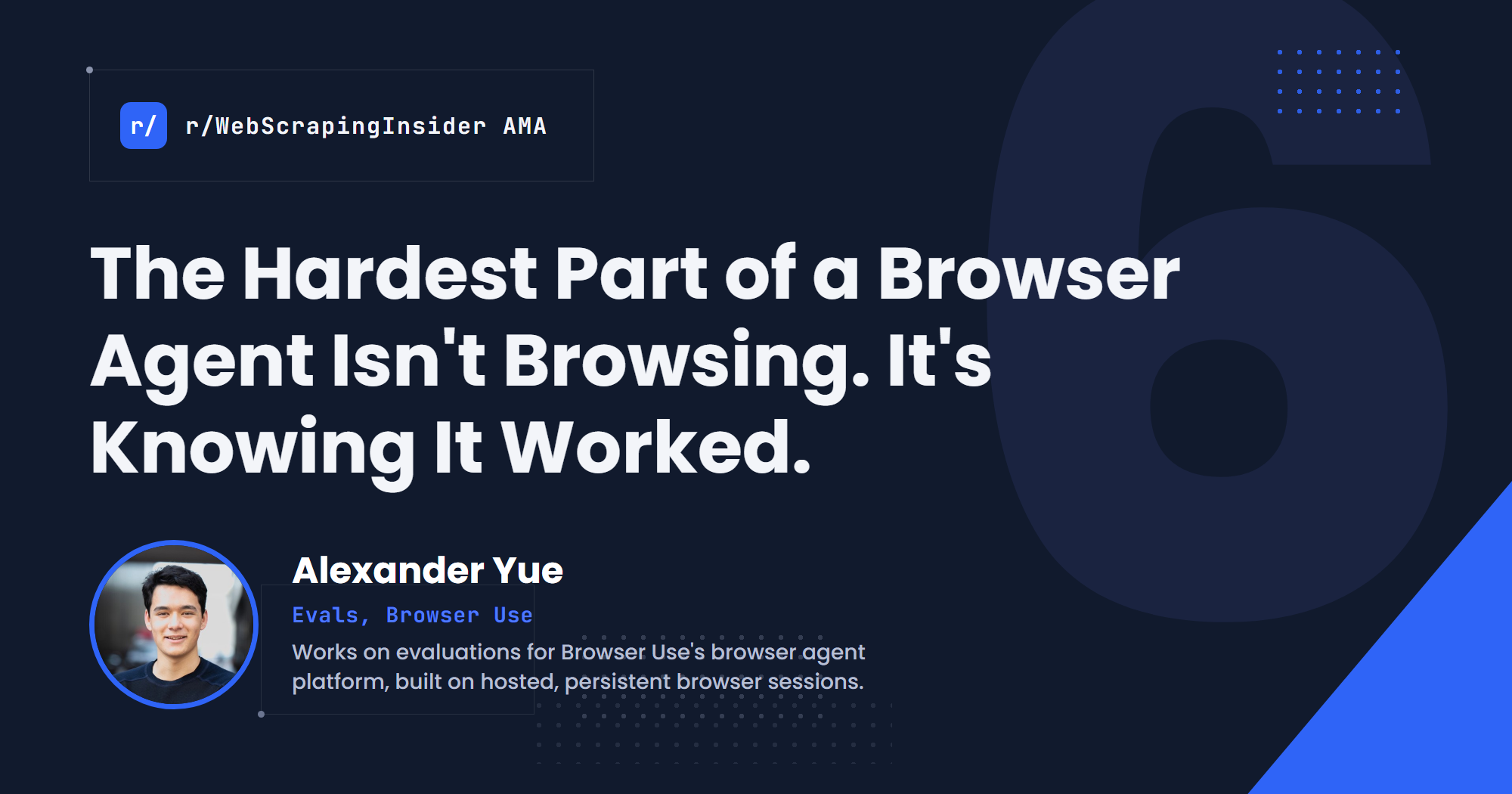
The Hardest Part of a Browser Agent Isn't Browsing. It's Knowing It Worked.

From the AMA

An agent can click every button correctly and still fail the task. This AMA is about what sits underneath that: persistent identity, stealth that never holds still, and the harder problem of verifying a run actually did what it was supposed to.

Browser automation used to have a simple job. Give a program a browser, define the clicks, keep the selectors alive when the site changes.

Browser agents are making that job description obsolete. Current models can write browser code, recover from their own mistakes, and chain together workflows that used to take real engineering hours.

None of that turns out to be the hard part.

The hard part is what happens after the agent acts. Did it keep the identity it started with? Did the IP change under it mid-task? Did the run actually finish the job, or did it just perform a sequence of actions that looked right?

That split came up again and again in a Reddit AMA with Alexander Yue, who works on evaluations at Browser Use.

As Browser Use's Alexander Yue put it during our recent Reddit AMA:

Yue works on evaluations at Browser Use and on physics and CS research at Stanford SLAC. Browser Use's open source harness has passed 107k GitHub stars, and its newer v4 platform runs agents on hosted, persistent browser sessions instead of throwaway headless instances. He was joined in the thread by Reagan Hsu, Browser Use's founding engineer, though the questions below were answered by Yue.

In our fourth r/WebScrapingInsider AMA, we asked Yue how much of the browser an agent should actually control, what identity survives between runs, why stealth resists a single score, and how anyone proves a run did the job.

Here are the six biggest insights from the discussion.
· 17 min read

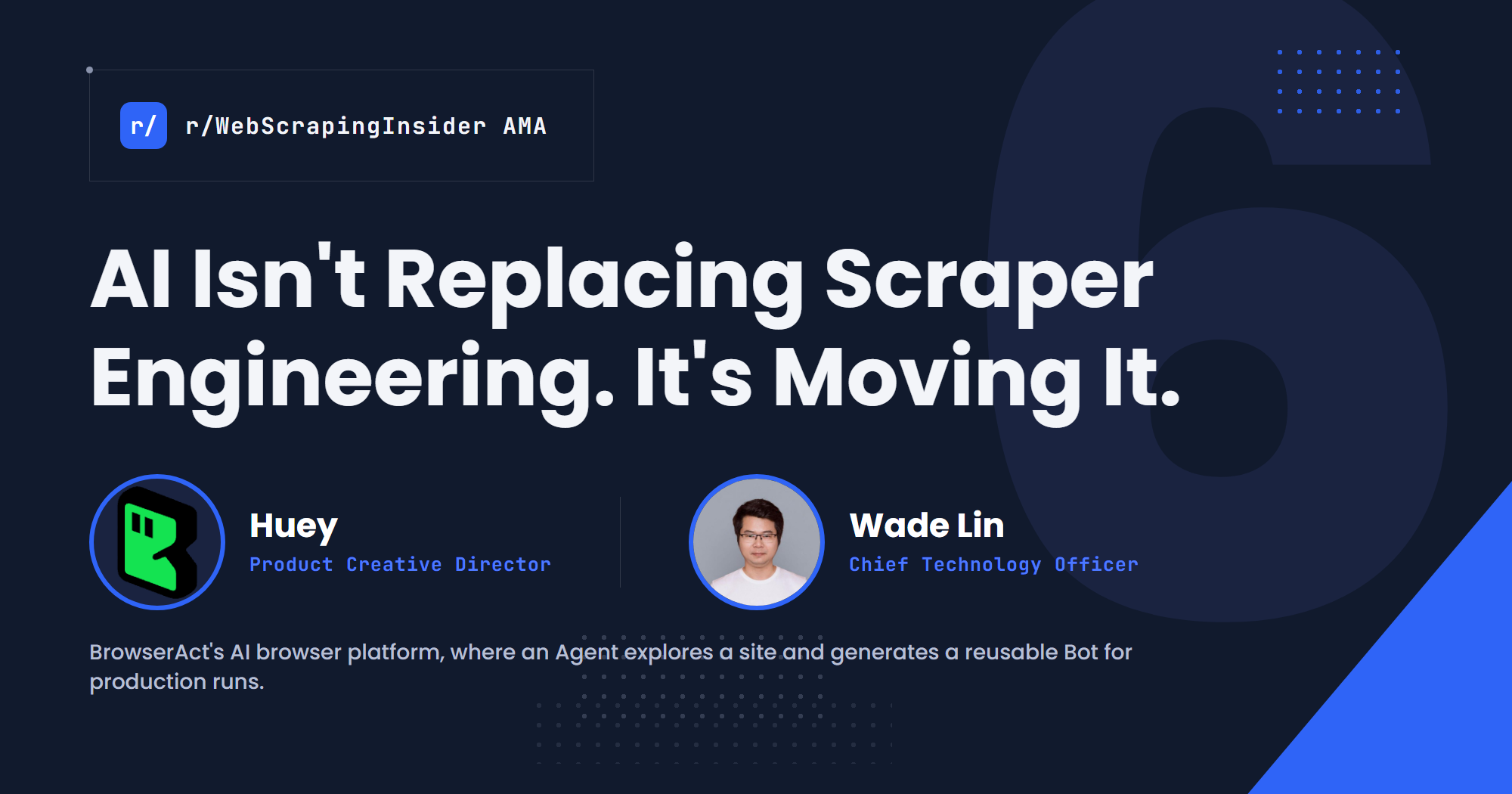
AI Isn't Replacing Scraper Engineering. It's Moving It.

From the AMA

An agent can write the scraper for you. Production still depends on everything around it: validation, deterministic execution, session trust, and hard limits on autonomous repair.

A production scraper can fail loudly. A selector breaks, a request times out, a CAPTCHA appears, the job crashes.

Those failures are the easy ones. They page you.

The dangerous failure is the one that looks healthy. The run is green, the row count is plausible, the dashboard is quiet, and the data is wrong.

That failure mode gets worse when an AI agent builds the scraper, because the agent's misreading of the page does not stay a one-off mistake. It gets compiled into the thing that runs every day afterwards.

Which changes what you should be asking about AI scraping. Not whether an agent can find the data and generate a scraper, but what happens after it decides: who checks the result, which layer does the repeated work, what happens when the target stops trusting the session, and how much the system is allowed to change on its own.

As BrowserAct's Product Creative Director Huey put it during our recent Reddit AMA:

Huey works on BrowserAct, an AI browser automation platform where an Agent explores a target site in a real cloud browser and generates a reusable Bot that handles the repeated runs. He was joined by Wade Lin, BrowserAct's CTO, whose team runs the browser runtime, proxy and cloud-execution layers underneath that Agent.

In our seventh r/WebScrapingInsider AMA, we asked Huey and Wade where AI actually belongs in a production scraper, what it still cannot solve, and how much autonomy a self-repairing system should be given.

The interesting part is how constrained their answers were. Here are the six biggest insights from the discussion.
· 25 min read

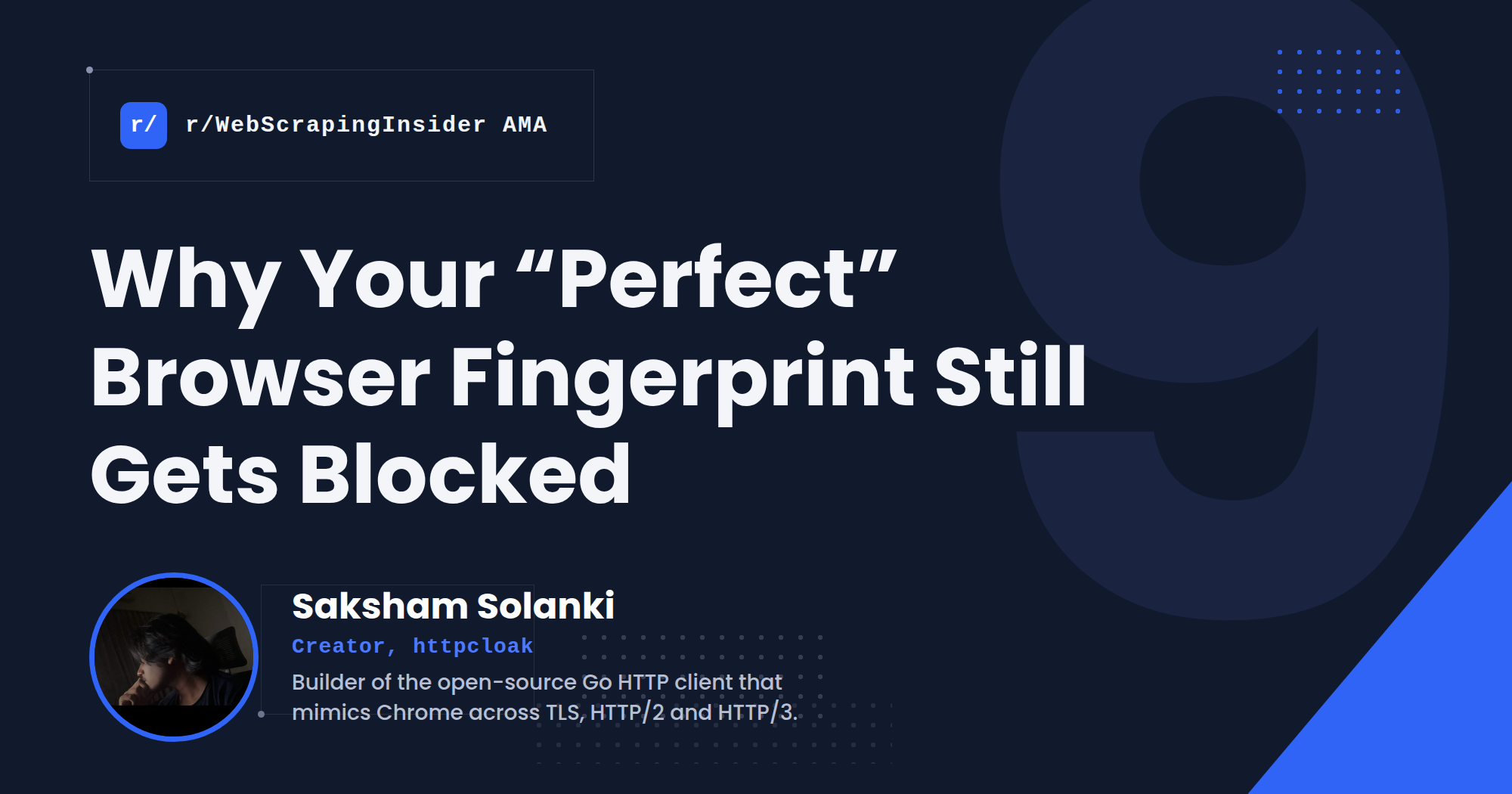
Why Your "Perfect" Browser Fingerprint Still Gets Blocked

From the AMA

A scraper is not judged only by whether its fingerprint looks like Chrome, but by whether its IP, cookies and connection history continue to describe the same believable browser.

When a scraper starts getting blocked, the standard advice is predictable.

Change the User-Agent. Add the missing headers. Rotate the proxy. Generate new cookies. Try another Chrome profile. If none of that works, rotate everything more often.

But every one of those components can look valid on its own while becoming contradictory when combined. A Chrome User-Agent can be paired with the wrong TLS behavior. A valid cookie can appear from the wrong IP. One persistent cart token can jump between five supposed devices.

That problem becomes more visible at production scale. One request may look perfectly ordinary. A thousand sessions following the same sequence, timing and teardown can reveal the automation template behind them.

As Saksham Solanki, creator of the open-source HTTP client httpcloak, put it during our recent Reddit AMA:

Saksham built httpcloak, a Go HTTP client designed to reproduce browser behavior across TLS, HTTP/2, HTTP/3 and the connection lifecycle, while working against a Cloudflare-protected target that was scoring on TLS and running HTTP/3. His experience comes from capturing browser traffic, comparing Chrome's networking behavior at the frame and byte level, and repeatedly correcting cases where httpcloak passed every public fingerprint test but still differed from Chrome underneath.

In our sixth r/WebScrapingInsider AMA, we asked Saksham why apparently browser-identical clients still get blocked, how identity breaks across proxies and sessions, where HTTP clients stop being sufficient, and what browser-impersonation product claims hide.

Here are the nine biggest insights from the discussion.
· 18 min read

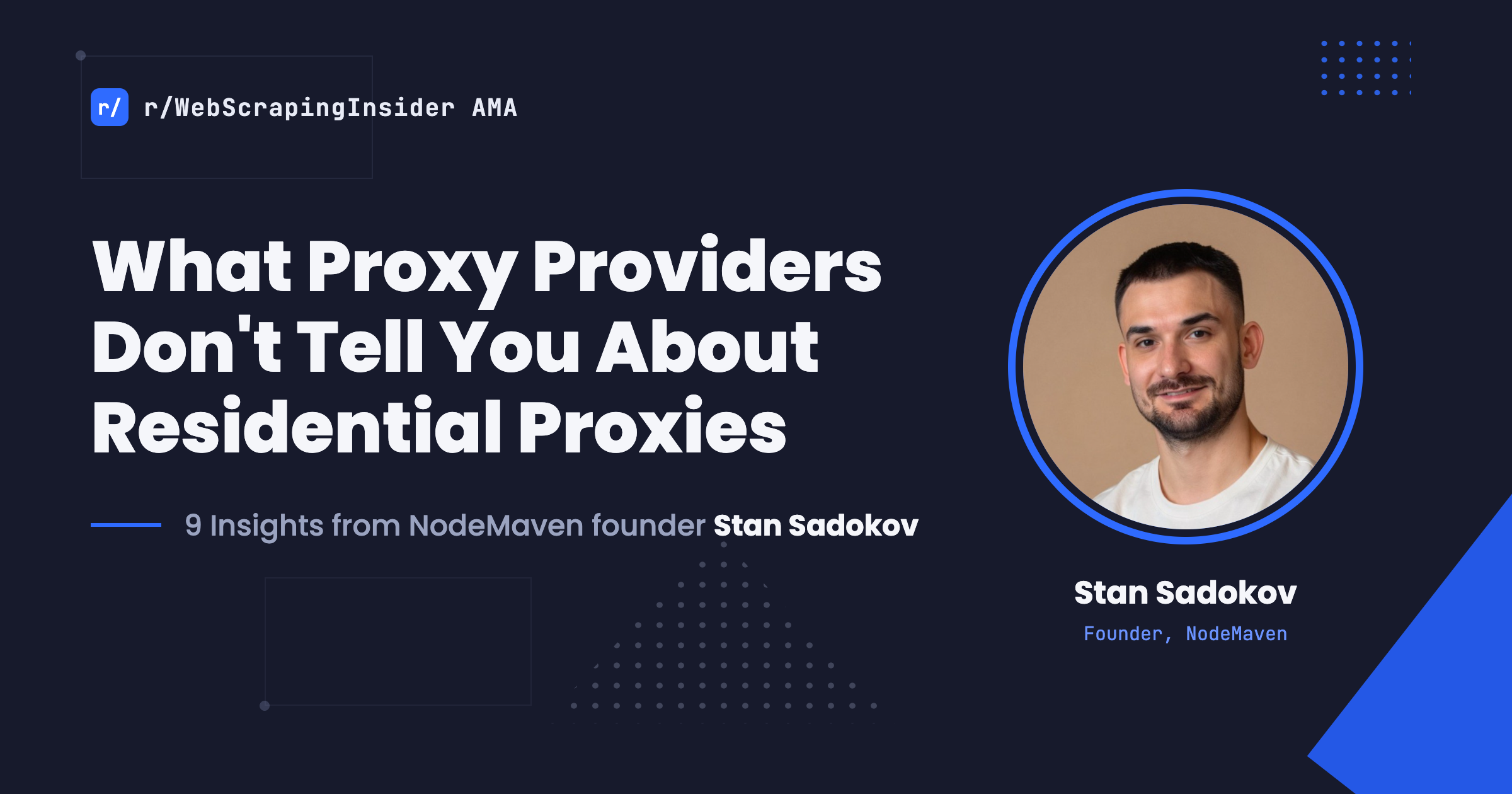
What Proxy Providers Don't Tell You About Residential Proxies

From the AMA

Inside the shared supply, real-time filtering and misleading metrics that determine whether a residential proxy network actually performs.

A residential proxy provider may advertise 150 million IPs, a 98% success rate and its own "premium" network.

None of those claims tells you whether it will work for your scraper.

Behind the marketing, providers frequently combine directly acquired IPs with third-party supply. The same addresses appear across multiple networks. An IP that works on one website can be completely unusable on another.

What separates providers may not be the pool itself, but the filtering, routing and session-management layer sitting between that raw supply and your scraper.

As NodeMaven's founder Stan Sadokov put it during our recent Reddit AMA:

Stan spent years working on browser fingerprinting and anti-detect technology at Multilogin before founding NodeMaven. During that time, he repeatedly saw apparently correct browser configurations fail because of problems at the proxy layer.

In our fifth r/WebScrapingInsider AMA, we asked Stan how residential proxy networks really work, what separates high-quality providers from weak ones and how developers should evaluate them.

Here are the nine biggest insights from the discussion.