The best proxy provider is not a company. It is whichever provider produces a usable result most cheaply for your website, page type and volume, and because provider efficiency is so uneven, at scale that choice becomes a routing and validation problem.
Every few weeks someone asks me the same question: which proxy provider is the best?
It is a reasonable question. Every comparison post on Google promises an answer. Every provider's homepage claims to be it.
And every developer who has burned a weekend switching providers wants a name they can stop thinking about.
There isn't one.
At ScrapeOps we currently route billions of requests a month through more than 50 proxy providers and scraping APIs. The same provider can be the cheapest, fastest option on one e-commerce site and one of the worst on another.
The winner can change between a product page and a search page on the same domain. It changes again when volume goes from 10,000 pages to 1 million.
What you are actually buying is not "a proxy". You are buying how efficiently a particular provider has learned to solve a particular target.
That efficiency is uneven, commercially motivated, and hidden behind headline prices that rarely survive contact with a real URL.
For our eighth r/WebScrapingInsider AMA I sat in the guest seat myself and opened up four years of provider benchmarking data to the community. If I had to compress the whole thread into two sentences, it would be these:
There is no best proxy provider. There is only the best provider for your websites, workload and volume.
For context on where this comes from: I am the CEO and Co-Founder of ScrapeOps, a proxy aggregator that routes traffic across the proxy provider market and benchmarks providers against each other in production, across roughly 60,000 domains.
Before ScrapeOps I worked at ScraperAPI, one of the companies that established the modern web scraping API model. So I have seen this industry from both the provider side and the buyer side.
In the AMA, the community asked how to actually compare providers, why two providers can charge 20x apart for the same page, what success rate hides, and where the economics of anti-scraping are heading.
Here are the nine biggest insights from the discussion.
1. There Is No Best Proxy Provider
The most common question in proxy buying is also the one with the least useful answer.
After four years of routing billions of pages through the provider market, the clearest pattern we have found is not a winner. It is that the winner keeps moving.
When someone in the AMA asked whether there was one provider I would default to for most projects, I did not hedge:
There really isn't one best provider. I know that sounds like I'm avoiding the question, but it's probably the clearest conclusion we've reached after four years of routing billions of pages through them.
The reason is that "best" has too many dependencies to be a fixed fact. The target website is the obvious one.
But the ranking is not even stable inside a single domain:
We've seen providers work brilliantly on Amazon and then perform badly on another e-commerce site. The winner can even change within the same domain. Product pages, search pages, reviews and internal APIs can have different protection and pricing.
Then volume changes it again. Every provider has a different pricing curve, so the provider offering the best value at 10,000 pages can become expensive at 1 million.
Add geography, JavaScript rendering, residential requirements or session handling and the shortlist reshuffles once more.
This is why recommendations are so unreliable, including the ones in this article. My own filter for any claim about a provider:
Whenever someone says a provider is amazing, my first question is: amazing for which website, at what volume?
The practical alternative to a single ranking is to segment first.
Small or intermittent projects need true pay-as-you-go pricing. Heavily protected targets need at least one provider that specializes in advanced anti-bot bypasses. Large enterprises may weigh procurement, compliance, contracts and geographic coverage as heavily as raw performance.
Only then do you test the actual target and cut the shortlist on performance and cost.
The providers should emerge from the requirements. You shouldn't choose the provider first and then try to force every website through it.
We published the benchmark data behind this conclusion in our proxy provider analysis. The short version: the leaderboard changes by domain, and price does not predict where a provider lands on it.
2. Website Access Should Be Priced Like a Commodity. It Isn't.
Send the same URL through two scraping APIs. Both return the page. One bills you 1 credit. The other bills you 20 credits.
They are selling you the same outcome. They are not producing it the same way.
One redditor asked why pricing is so inconsistent between scraping APIs when both providers return usable results, and whether buyers were simply being "rinsed by the SaaS gods".
I started with what access to a page should look like as a market:
My view is that website access should eventually become something like electricity. You request a page, receive a valid response and pay a relatively standardized price for that access.
Some websites should cost more because their protection is stronger. That part is reasonable.
What makes little sense from the customer's side is that the same page, from the same site, can cost 10x or 20x more depending on which supplier you happened to pick.
The reason is that a provider's price does not only encode how hard the site is. It encodes how that provider has learned to solve it:
One provider might solve the website using datacenter proxies and charge one credit. Another might only know how to solve it using residential proxies, browser rendering or multiple attempts, so it charges 10 or 20 credits.
You are not only paying for how difficult the website is. You're paying for how efficiently that particular provider knows how to scrape it.
A natural follow-up was whether those differences are mostly margin. It can be either, but often the expensive provider's costs genuinely are much higher.
Rendering a browser, burning residential bandwidth and making several attempts before returning 1 success costs far more than 1 HTTP request through a datacenter IP.
That leaves the buyer with an uncomfortable ambiguity:
A higher price can mean a better solution. It can also mean the provider is using a much more expensive method to return the same page.
From the outside, the number does not tell you which. Only a test on your actual target does.
3. The Anti-Bot Tax Has Widened the Gap Between Providers
If access should be a commodity, why has the market drifted so far from one?
Part of the answer is history. When someone asked whether scraping has genuinely become harder even as the tools improved, I went back to my time on the provider side:
Before ScrapeOps, I worked at ScraperAPI. At that time, from what I remember, probably 90% to 95% of traffic could be scraped at the basic one-credit level. Residential proxies and JavaScript rendering were relatively exceptional.
Today my rough estimate is that 20% to 25% of traffic needs something beyond the base configuration: residential proxies, browser rendering, premium pools or advanced anti-bot bypasses.
Proxies themselves got cheaper. The cost of one genuinely successful scrape went up.
The market became much more inefficient when advanced bypasses stopped being an edge case. That is the anti-bot tax we are paying now.
This is what turned provider choice from a rounding error into a first-order decision.
Base prices between providers are often within 10% or 20% of each other. Advanced configurations are where one provider charges 1 credit for a domain and another charges 10 or 25.
The gap between an efficient provider and an inefficient one is now measured in multiples, not percentages.
The second part of the answer is that providers close that gap selectively.
A redditor complained that whenever a target starts failing, support's answer is "enable residential proxies or JS rendering", and asked whether providers ever actually fix the bypass. The honest answer is that it comes down to economics:
If Amazon stops working, the provider probably has many customers affected and a substantial amount of revenue at risk. It has a strong reason to put engineers on the problem and find an efficient fix.
If you're the only customer scraping an obscure website in one country, the calculation is different. The provider might be capable of developing a cheaper solution, but it may not be worth the engineering time.
The easiest answer in that situation is to tell you to switch on residential proxies or JavaScript rendering and raise your cost 10x.
Popular targets get custom, efficient solutions. Obscure targets stay on the expensive fallback, not because they are harder, but because nobody is paid to optimize them.
Providers fix the domains they cannot afford to lose. Their technical priorities follow customer demand and revenue like any other business.
There is a practical move hiding in this. If your target is obscure, it is sometimes better to be a big fish in a small pond.
A smaller provider for whom you are a meaningful account has a real reason to engineer your domain. To a large provider you are a rounding error, and the cheapest thing they can do is recommend the 10x configuration.
Sometimes. Not always. The small provider still has to be technically capable, and I generally prefer providers where scraping is the team's core business, not one API among dozens of unrelated products.
4. The Real Price Is the Cost of a Usable Result
A plan says $100 per million requests. You sign up, send your first real URL, and it fails.
You open a support ticket. Support replies that this site needs residential proxies, which cost 10 credits per request.
Your $100 per million just became $1,000 per million. The pricing page was never the price.
I called credit multipliers "probably the biggest pricing trap in the web scraping API market" in the AMA, and the arithmetic is simple. 5 credits per request turns $100 per million into $500. Add residential or rendering and you are at 10x or 20x your original calculation.
Compared with that, the differences in base rates that buyers spend their time negotiating are noise:
The biggest savings rarely come from negotiating a slightly cheaper base rate. They come from choosing the provider with the lowest multiplier in the first place.
The second layer is the billing model. Providers charge per successful request, per gigabyte, per API credit, per concurrent thread or through dynamic pricing, and each model produces a different winner for a different shape of traffic.
Per-GB pricing can be extremely cheap for small responses. Using published prices, 1 million 10 KB responses would cost approximately $56 through Oxylabs Web Unblocker versus $1,500 through a provider charging $1.50 per 1,000 successes. That advantage disappears as responses grow.
Concurrency pricing, like GeoNode's, can be excellent when you keep every thread occupied around the clock and poor when traffic is intermittent.
I wouldn't ask which billing model is best generally. I'd ask which model creates the lowest cost for the shape of your workload.
The third layer is the one most benchmarks get wrong. Success rate looks like the obvious metric. It is not:
Success rate alone can be misleading. One provider might have a 99% success rate but take 20 to 30 seconds per response. Another might succeed only 80% of the time but return successes in two or three seconds and failures within 10 seconds. With the same concurrency, the second provider could process far more successful pages.
The metric we use internally instead is average time to a successful response: total latency across all attempts divided by the number of successful responses.
As a rough guide, under 5 seconds is very good, under 10 is good, and 20 to 30 seconds is where performance starts looking much weaker.
Speed then feeds back into cost depending on the billing model. Under concurrency pricing, faster responses free threads sooner. Under bandwidth pricing, response size dominates. Under per-success pricing, failed attempts are mostly the provider's problem.
Which is also why the fastest provider is not automatically the best value. A provider that returns the page in 5 seconds instead of 3 but costs 80% less may be the right choice, depending on whether those 2 seconds matter to your application.
You have to evaluate performance and pricing together. Paying more can buy better performance, but the relationship is surprisingly weak.
The last layer is whether the expensive configuration was ever needed.
The test is simple. If several scraping APIs return the page at their basic 1-credit level, residential proxies or full browser rendering are probably not fundamentally required. If nearly every provider needs them, the site probably does.
I wouldn't blindly accept "enable premium proxies" as the diagnosis. Sometimes that is correct, but it is also the easiest recommendation for support to make.
5. The Code for a Benchmark Is Not the Moat. Unbiased Traffic Is.
If the only reliable answer is "test your target", the obvious next question is how much testing you can trust.
Writing a proxy benchmark is easy now. Normalize the integrations, send identical requests through each provider, compare success rate, response time and cost. A coding agent can generate most of the integration code from the providers' documentation.
The hard part is not the code.
The hard part is funding enough traffic to trust the results. You need paid accounts, multiple URLs and page types, realistic concurrency, tests at different times and independent response validation.
Testing 10 to 20 providers properly can easily cost $500 to $1,000 before you have scraped a single page of production data.
Free trials rarely help. They seldom include enough credits for a meaningful sample once an advanced configuration is consuming 10 or 25 credits per request.
The code for a proxy benchmark isn't really the moat. Paying for enough unbiased traffic to trust the result is the moat.
A redditor suggested the obvious shortcut: email providers and ask for bigger trials. My reply was five words long: "You can, but then they know they are being benchmarked."
I am not saying every provider will manipulate the result. But once a provider knows a specific account is a test, there is at least the possibility that its requests receive different routing or more attention than ordinary customer traffic.
We test through normal paid accounts for exactly this reason.
The same skepticism applies to benchmarks published by providers themselves:
I've noticed that when a proxy provider publishes its own benchmark, it somehow nearly always finishes first. Those results often don't match what we see in production.
Even an honest benchmark is only a snapshot. What we do internally is combine a few hundred controlled tests against a domain like Amazon with the hundreds of millions of Amazon pages already flowing through the system:
A small benchmark gives you a snapshot. Production traffic shows whether the result holds up over time, across different URLs and under actual load.
For a team that cannot fund all of that, the realistic method is three steps. Run a broad initial test to find the strongest candidates. Shortlist the top 3. Then test those 3 properly with your real URLs, configurations and expected load.
That is what our free Proxy Tester is for, and I was explicit in the AMA that its results are a pointer toward the right 3 providers, not a final benchmark.
Whatever you find, do not sign an annual commitment off a short trial. Ramp real traffic gradually and let the provider prove itself in production.
Retesting, finally, should be event-driven rather than calendar-driven. If performance, pricing and workload are stable, a broad check every 6 to 12 months may be enough.
Retest immediately when success rates drop, latency deteriorates, prices or credit multipliers change, or your workload changes shape.
6. Brand, Rankings and Reviews Tell You Who Won Marketing, Not Who Will Be the Best Provider for Your Use Case
Big brand. First on Google. 4.5 stars. A 99% success rate on the sales deck. A pool of 100 million IPs.
None of these numbers can tell you what happens when you send your URL.
Start with brand. A redditor admitted he had defaulted to the big providers because it felt safer, and wondered whether he was just paying for the name.
I wanted to give the big brands their due before drawing the line:
The established providers can be safer organizationally, but they are not automatically better technically.
Procurement, compliance, geographic coverage, contracts and platform breadth are real advantages, particularly for enterprises.
But on the cost and performance of scraping a specific website, smaller providers regularly outperform the biggest names. Some of the best providers we work with are remote teams of 3 to 10 people with almost no visibility on Google.
Brand recognition tells you who won distribution. It doesn't tell you who will win your workload.
Size can even work against technical understanding. In a large provider, only a small share of staff work on the scraping infrastructure. The rest may sincerely believe the product is the best because that is the story repeated internally.
Nor does being first guarantee staying best. I tried to be fair about ScraperAPI, where I used to work: it established the modern scraping API model and was best-in-class at the time.
My view now is that the market has since moved faster on response times and cost-to-performance, and that "being a category pioneer doesn't guarantee permanent technical leadership".
Then there are the rankings. Asked how much attention to pay to "top 10 proxy providers" posts, my answer was "very little", and the reason is first-hand:
We regularly receive emails from people who have published proxy rankings and want us to pay for a position. Sometimes they want an affiliate arrangement, sometimes a monthly payment, and sometimes the publisher owns the provider ranked first.
Not every comparison is dishonest. But a lot of "best proxy provider" pages are effectively advertising inventory presented as editorial judgment.
Then the problem compounds. Those pages rank, other writers cite them, AI assistants repeat them, and eventually a commercially influenced ranking starts looking like independent industry consensus.
Review sites are a little better, but only for one thing. Repeated operational complaints about unexplained billing, downtime, account suspensions or vanishing support are worth knowing.
"This provider is amazing" is not, because you do not know what they scraped, at what volume, with which configuration. Reviews can flag an unreliable company. They cannot tell you which provider will perform best on your target.
The same goes for the numbers a salesperson will give you. A generic 99% success rate can hide a bad result on the one domain you care about, and estimates of how much traffic a provider already handles on your target are unverifiable.
We don't ask providers to tell us whether they're good. We send them traffic and measure what comes back.
There is one signal that does carry information, and it only appears after you have started sending traffic.
When your target breaks, does the technical team investigate? Does performance recover? Do they restore the cheaper configuration, or does support immediately recommend the most expensive one?
What providers do when a target breaks tells you much more than what they say during the sales process.

7. The Most Dangerous Failure Is a 200 That Looks Correct
A blocked request is the cheapest failure you will ever have. It costs one retry.
The failure that hurts is the one that looks like success.
A redditor scaling up a multi-site scraper asked how to validate responses when a page returns 200, looks normal, and is quietly missing a key field.
There are really two kinds of failure here. Block pages, CAPTCHAs and error responses have recognizable signatures, fail visibly and can be retried. The other kind is different:
Maybe you requested a US page but received another geographic version. The currency could be wrong, certain sellers might be missing, the price could be regional or the search results could be incomplete. It looks like a successful response, so it quietly enters your database.
The biggest risk here is believing you successfully collected the correct data when you didn't. A failed request costs another request. A convincing but incorrect response can make the entire dataset untrustworthy.
This is where "success rate" quietly splits into two different numbers.
For a proxy provider, success normally means a valid-looking response that is not an obvious block, CAPTCHA or login page, with HTML that looks like the expected page. For certain targets there is some basic validation, such as correct geolocation.
For major sites like Amazon, Google or Walmart, providers can add custom checks on currency, location, availability or required elements.
The end user's definition is stricter: did I receive the complete and accurate data I needed? A 200 with incomplete or incorrect prices, URLs, rankings or availability is not a success, whatever the provider's dashboard says.
Someone asked where the provider's responsibility ends, and I think it is important to be honest about the limit.
We handle traffic across roughly 60,000 domains and potentially millions of page types, and we generally return HTML. We can detect common block pages, CAPTCHAs and certain geolocation problems. We cannot know what every product should cost or how many sellers should appear.
Infrastructure providers can verify that a response looks technically valid. Only the data consumer has enough context to determine whether the information itself is correct.
That final validation has to happen closer to the business: expected-field checks, historical comparisons, geographic consistency checks, anomaly detection.
It is also the least solved part of the whole problem. Hard-coded validation is expensive to maintain across thousands of page types, and running every response through an LLM is currently far too costly.
Which raises the question one redditor asked next: will websites eventually return fake data to suspected scrapers instead of a block page?
I think that is one of the biggest potential future threats:
A website could return believable but incorrect pricing, inventory, rankings or listings. Everything would appear to work, making it much harder to detect than a CAPTCHA or block page.
The main reason it has not been widely deployed is probably the danger of serving false information to legitimate users. A site would need extremely high confidence that a visitor was automated.
But as detection systems improve, that confidence gets easier to reach. And infrastructure providers would be poorly placed to notice, because we do not know what the correct data should be.
If detection systems become confident enough, the next generation of anti-scraping may not stop you from collecting data. It may make you collect data you cannot trust.
8. Websites Do Not Need to Block You to Make Scraping Uneconomical
The page loads. There is no CAPTCHA, no 403, no block page.
There is just a login wall. Or a redirect to resolve. Or 10 requests where there used to be 1.
And the data you wanted now costs 2x as much to collect.
A redditor noticed that his recent scraping problems were not blocks at all but extra steps, and asked whether sites are moving away from obvious blocking. I think this is becoming a much bigger part of the problem:
Websites do not need to block scraping to make it uneconomical. They only need to add enough friction to increase the cost of every record.
When someone else asked about Google's move to redirect-style result links, I laid out the three broad approaches a website can take.
It can block suspected scrapers, which works but also catches legitimate users. It can put data behind logins, which is operationally harder to scrape and raises legal exposure because scrapers must accept the terms.
Or it can change the economics: not block anything, just make the same data require much more work.
Google is the clearest example of the third approach.
Over the last couple of years it has required JavaScript rendering for certain results, removed the parameter that returned 100 results in 1 request, forced suspicious users to log in, and introduced redirect links that must be resolved to recover destination URLs.
Not all of these hurt equally:
Removing 100-result pages had a much bigger impact. Getting 100 results can now require 10 requests instead of one, with no real workaround.
JavaScript rendering can theoretically raise costs 2x to 10x, though providers have found lightweight ways to handle it. Login requirements behave like traditional blocking. Redirect links add a processing step to every result.
And the reason it works is that none of it registers for a real person:
The clever part is that these changes barely affect real users. They already use browsers, usually view only the first page, are often logged in, and won't notice a redirect when clicking a result.
The pattern generalizes well beyond Google: public information moved behind a login, direct links replaced with redirects, an extra request to resolve every destination, data split across several endpoints, partial content until JavaScript executes.
The information is still accessible, but part of the workload may have effectively doubled.
One redditor pushed back that many of these changes are really about tracking, security or account growth, not scraping. That is true, and it does not matter:
From the scraper's perspective, intent matters less than the result.
Which leads to the economic reframe underneath the whole AMA. Almost every website is technically scrapable if you are willing to spend enough money and engineering time.
The real question is whether the value of the data exceeds the proxies, retries, browsers, CAPTCHA handling, account management, validation and engineering required to collect it.
We explored that idea in more depth in Scraping Shock, and my summary of it in the AMA was two sentences long:
The web isn't necessarily becoming inaccessible. It is being repriced. Access remains possible, but fewer datasets are profitable to collect at scale.
9. At Scale, the Best Proxy Provider Is a Routing and Validation System
For a hobby project, pick a pay-as-you-go provider and get on with building.
For a serious multi-domain operation, the question "which provider?" eventually stops having a name as the answer.
A team doing a few million requests a month asked when it makes sense to integrate multiple providers, given that managing several accounts and APIs "sounds like a pain".
The answer scales with the reader. For a hobby project, don't bother. For a growing business on one stable domain with one provider performing well, 5 integrations may create more work than value.
But past a certain size the logic flips:
At larger scale, relying on one provider eventually becomes expensive or risky. The best provider changes by domain, page type, volume and required functionality.
Performance can also deteriorate the moment a website changes its protection. And the failure mode to avoid is specific: one provider stops working and your only available option is switching on a configuration that costs 10x more.
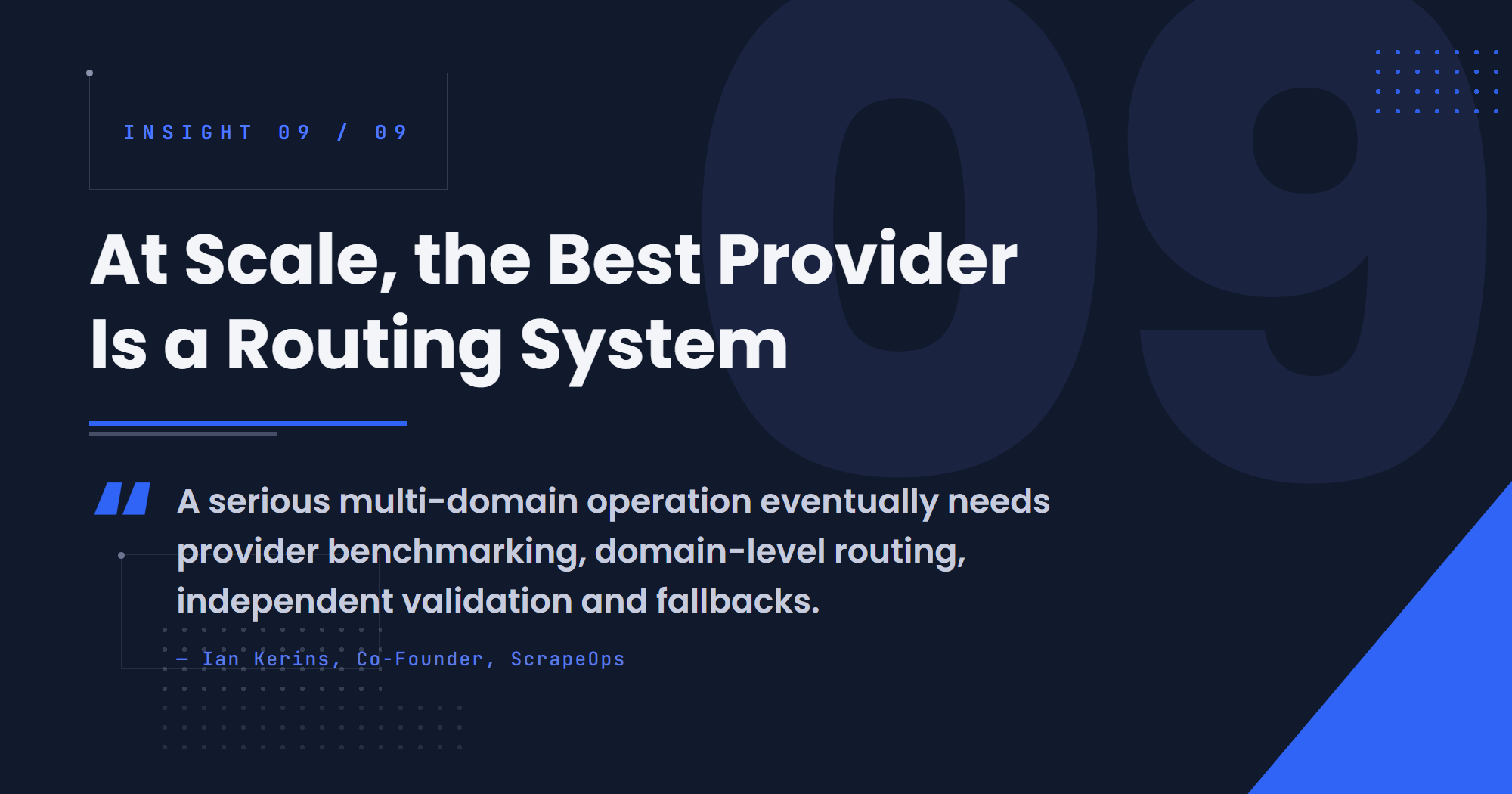
A serious multi-domain operation eventually needs provider benchmarking, domain-level routing, independent validation and fallbacks.
The follow-up was the one every engineering team asks: couldn't we just build that ourselves?
Yes, and the routing logic itself is not particularly difficult. The hard part is everything required to make the decisions reliable.
Maintaining the provider integrations. Paying for accounts across the market. Running continuous benchmarks. Validating responses. Tracking pricing and credit changes. Reconciling provider billing. Collecting enough production data. Moving traffic safely when performance changes.
You can reproduce the routing code. What is much harder to reproduce is the provider coverage, purchasing infrastructure and production data behind the routing decisions.
That is, in fairness, what we built ScrapeOps to do: one integration from the customer's perspective, routing across the broader provider market underneath.
It is not the only way to get there. Zyte API takes a different approach by pricing each request dynamically on its actual difficulty, which solves part of the same problem within a single provider.
Either way, the decision rule is the same:
If web data is critical to the business, you need either multiple providers behind your own routing system or one integration that gives you access to that diversification.
It is worth being honest about how solved this is.
When someone asked for the most annoying unsolved problem in the field, this was my answer: taking a URL and automatically determining the best provider, proxy type, geolocation, rendering requirement, headers, timeout, retry strategy and lowest-cost reliable setup, with near-total confidence.
That system doesn't fully exist yet. Our Proxy Aggregator handles much of the provider selection and routing, so I'd say we're around 60% to 70% of the way there.
The remaining gap is the one Section 7 described: understanding the ideal request setup for every page type, and validating that what comes back is genuinely correct rather than merely successful-looking.
Conclusion: The Best Proxy Provider Is a Process, Not a Name
The question that started this AMA was the wrong shape. "Best" implies a fixed ranking.
Everything in the discussion says the ranking is a function of website, page type, geography, volume, billing model and provider motivation. And most of the signals people use to shortcut that function are commercially contaminated.
The less useful questions are "Which provider is best?" and "Who has the biggest pool?"
The better ones are:
- Which domains, page types and volumes do I actually need, and what does that segment of the market look like?
- Can any provider return this page at its base configuration, or does the site genuinely require more?
- What does one validated, usable record cost me, after multipliers, retries, latency and billing model?
- Am I testing through a normal paid account, on my real URLs, at realistic concurrency?
- What did the provider do the last time my target broke?
- Is my success metric "non-block HTML", or "complete and correct data"?
For most readers the practical path is short. Define the workload, segment providers by it, run a broad independent test, shortlist 3, test them on real URLs through a normal paid account, compute cost per validated result and ramp gradually.
For teams whose business depends on web data, that process eventually has to run continuously, with routing, fallbacks and validation built in, whether you build it or buy access to it.
If there is one line from the AMA I would want people to take away, it is this one:
The important question is no longer only, "Can this website be scraped?" Almost every website is technically scrapable. The better question is whether the data remains valuable enough to justify the requests, accounts, browsers and engineering required to collect it.
Start with your single most important URL, send it through every provider you can afford to test, and calculate what one usable result actually costs. That number, not any ranking, is where the right provider comes from.