Ask ten scraping teams what the best proxy provider is, and you'll get ten confident answers.
They can't all be right. It turns out none of them are.
"What's the best proxy provider?" is the most common question in web scraping. It's also the wrong one.
There is no universal winner. The best provider depends on which sites you scrape and how many pages you pull, and the moment either of those changes, the answer changes with it.
We found that out by benchmarking the major Proxy APIs and residential providers against live performance data, then pricing every plan at 10k, 100k and 1M pages a month. We expected the usual pattern: pay more, get more. The data said something else.
The clearest finding in the whole dataset is that price and performance barely relate. Paying more does not reliably buy you a faster or more reliable scrape. Sometimes it does. Most of the time it doesn't. And you can't tell in advance which situation you're in.
There is no best proxy provider. There is only the best provider for your sites, at your volume, and the only way to find it is to measure it.
The rest of this piece is the evidence, in three steps. Price doesn't predict performance. The best provider changes with the site you're scraping. And it changes again with how much you're scraping. By the end, the case for testing your own workload makes itself.
- First, What "Best" Even Means
- Price Does Not Predict Performance
- The Best Provider Changes with the Site
- The Best Provider Changes with the Volume
- Takeaway: The Only Way To Find The Best Provider Is To Test Your Own Use Case
- Who Is The Best Proxy Provider?
- The Bottom Line
- Methodology
Need help scraping the web?
Then check out ScrapeOps, the complete toolkit for web scraping.


TLDR: There Is No Best Proxy Provider, Only The Best For Your Use Case.
We benchmarked major Web Scraping APIs and residential providers against live performance data, then priced every plan at 10k, 100k and 1M pages a month.
Three findings kill the idea of a universal winner:
- Price does not predict performance. On most sites, paying more does not buy a faster or more reliable scrape. For Proxy APIs at 100k pages, price barely tracked performance on 8 of 15 domains.
- The best provider changes with the site. Top-3 value rankings barely overlap across domains. Pick the wrong provider and you can pay 5–15X more for the same or worse results.
- The best provider changes with volume. Across 27 site tests, the winner stayed the same from 10k to 1M pages only about 15% of the time. A cheap pilot is a bad guide to who wins at scale.
If you need a single pick from the aggregate data: Zyte API and PlainProxies lead at hobby volume (10k pages). Scrape.do and PacketStream lead at enterprise volume (1M pages).
But the real answer is simpler. There is no best proxy provider, only the best for your sites at your volume. The only way to find it is to test your own use case.
First, What "Best" Even Means
Before any numbers, one definition, because "best" means nothing until you say best at what.
We looked at two kinds of proxies.
- Proxy APIs: the all-in-one endpoints that handle rotation, headers and unblocking for you, and
- Residential providers: the raw residential IPs you route your own requests through.
They're priced and used differently, so we kept them apart and ran every test twice, once for each market.
For every provider we measured two things:
- Cost: what each plan actually costs to scrape a set number of pages, priced at 10k, 100k and 1M pages a month.
- Performance: we used the metric average success latency to measure performance. It measures how long it takes a provider to return a valid successful request, which factors in both success rate and latency.
Put them together and you get the only number that matters when you're choosing: value, the performance you get per dollar at a given volume. A provider that's quick but three times the price of one nearly as quick is not the better buy.
One caveat before the charts. Correlation isn't causation.
Premium plans often get pointed at the hardest sites, which can drag their measured numbers down.
We're not claiming a high price makes a provider slow. We're claiming something more useful for anyone holding a credit card: the price doesn't tell you how a provider will perform on your sites.
Price Does Not Predict Performance
Start with the assumption almost everyone brings to this decision. You get what you pay for.
The expensive providers cost more because they're better, so paying more should buy you speed and reliability.
Unfortunately, that's not what the data says.
Take Amazon.com. One of the most scraped domains on the web. At 100k pages a month.
Web Scraping APIs
Here is every Proxy API plotted by what it costs against how fast it performs. If price bought performance, the points would form a line: cheap and slow in one corner, expensive and fast in the opposite one.
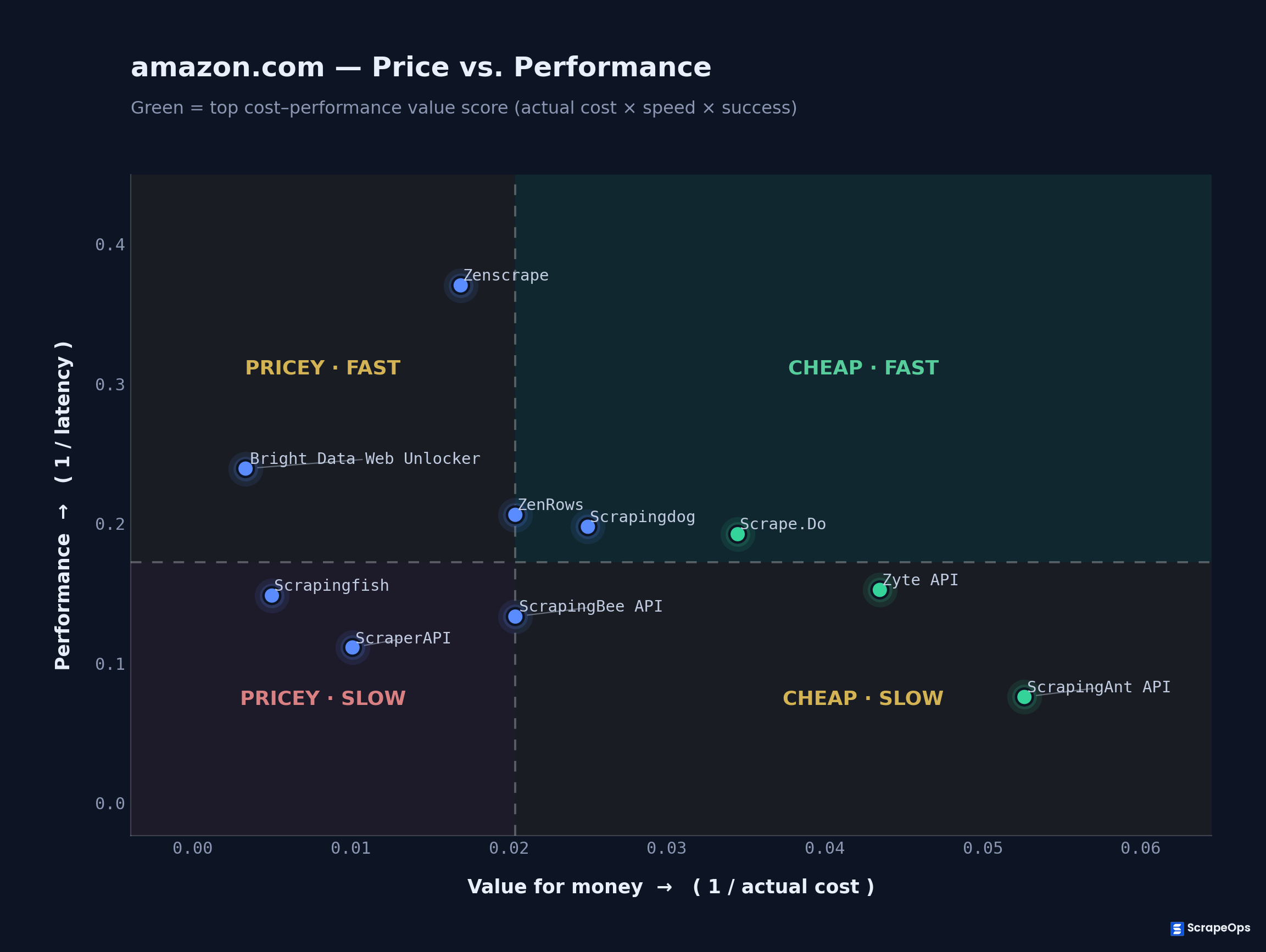
They don't form a line. They form a scattered cloud.
In fact there is pretty much no correlation between price and performance. A correlation coefficient of 0.35 to be precise.
Meaning that price explained only 12% of performance differences, leaving plenty of cheaper providers outperforming more expensive ones.
The most expensive option isn't the fastest. The cheapest options are among the slowest. And the best value sits in the middle of the pack, surrounded by providers charging wildly different prices for nearly identical results.
A single site could be a fluke. So we ran the same comparison across 15 high-traffic domains and asked one blunt question of each: does price reliably predict performance here?
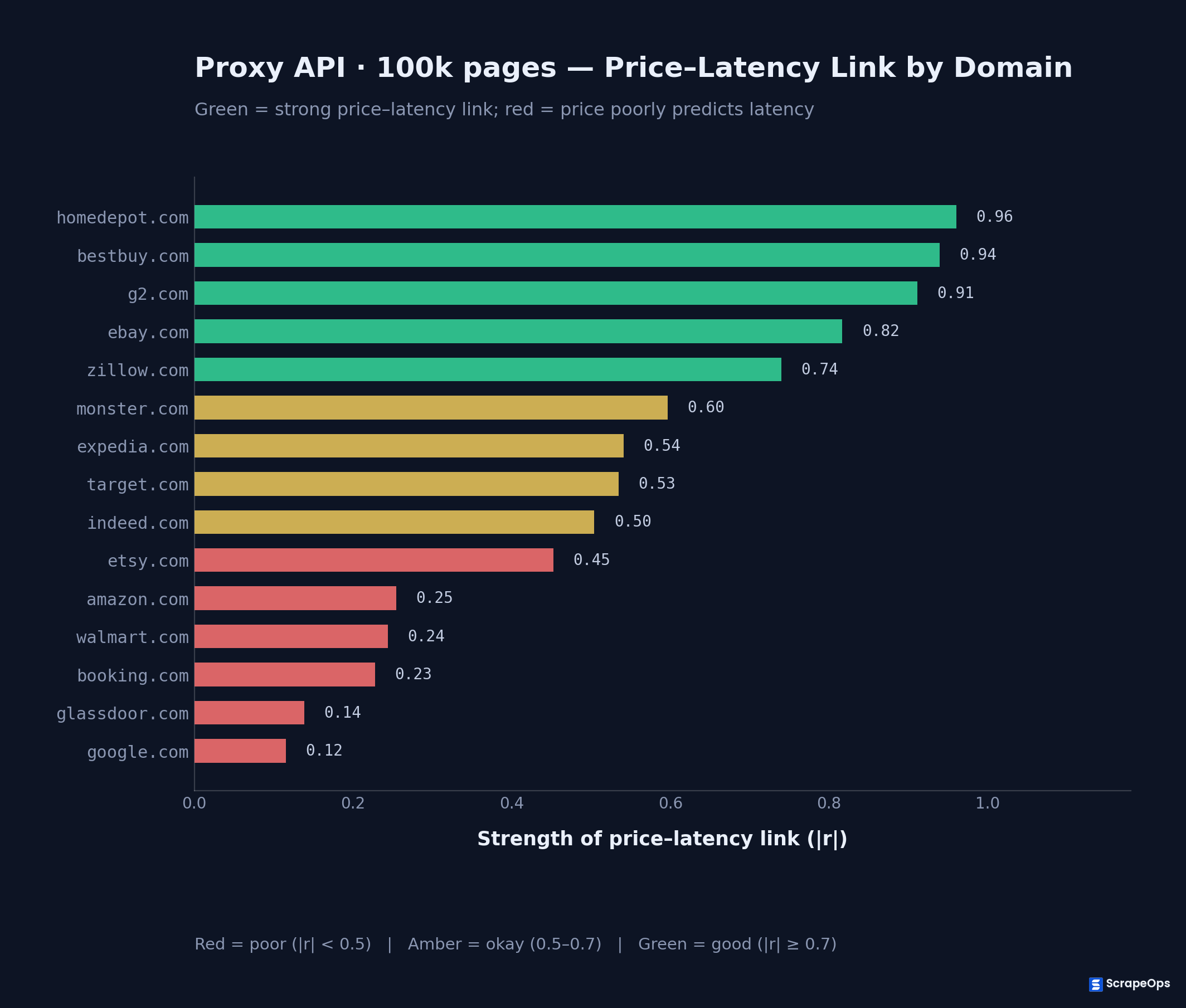
Across 15 sites, price is a poor guide on most of them.
On 8 of the 15, the answer is no. Price barely tracks performance.
On only 4 sites, Best Buy, G2, Target and eBay, does paying more reliably buy a faster scrape.
The remaining 3 sites, Glassdoor, Zillow and Expedia, land in the middle: a moderate link that wouldn't justify trusting a price tag alone.
The spread is the story.
| Domain | Correlation (|r|) | Takeaway |
|---|---|---|
| Home Depot | 0.96 | Almost a perfect price–latency link |
| Best Buy | 0.94 | Paying more reliably buys a faster scrape |
| Amazon | 0.25 | Price barely tracks performance |
| Walmart | 0.24 | Price barely tracks performance |
| 0.12 | Price and performance are essentially strangers |
On the domains teams scrape hardest, the expensive plan is often no faster than the cheap one.
On more than half the sites we tested, spending more is a coin flip.
We've seen that price doesn't predict performance on Web Scraping APIs. But what about residential providers? Do they fare better?
Residential providers
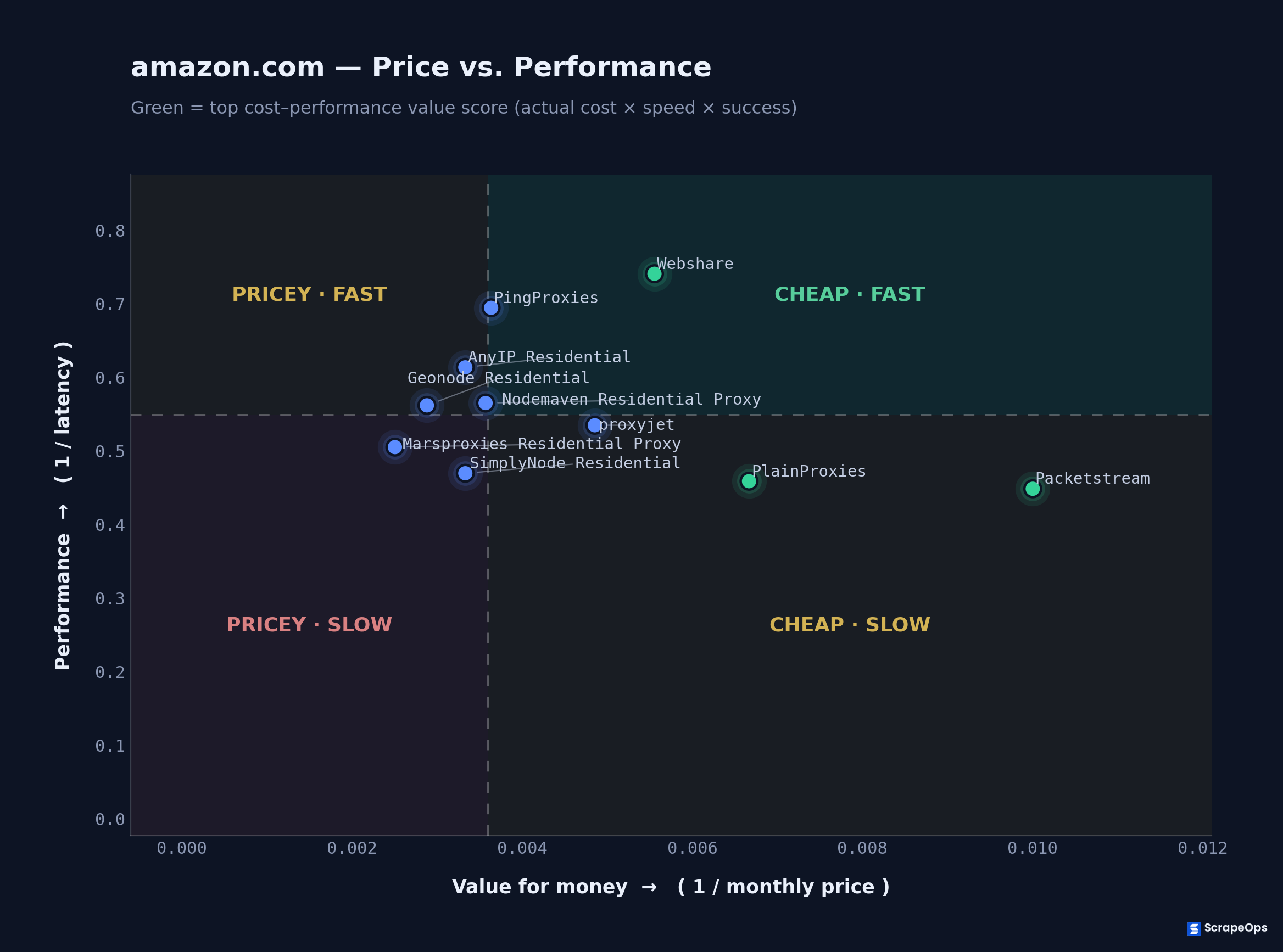
We ran the identical test on residential providers, a separate market with its own suppliers, its own pricing and its own economics.
For Amazon, at 100k pages a month we saw much better clustering of providers; however, the price-to-performance correlation is still lacking.
When expanded to 9 domains, we saw a similar pattern.
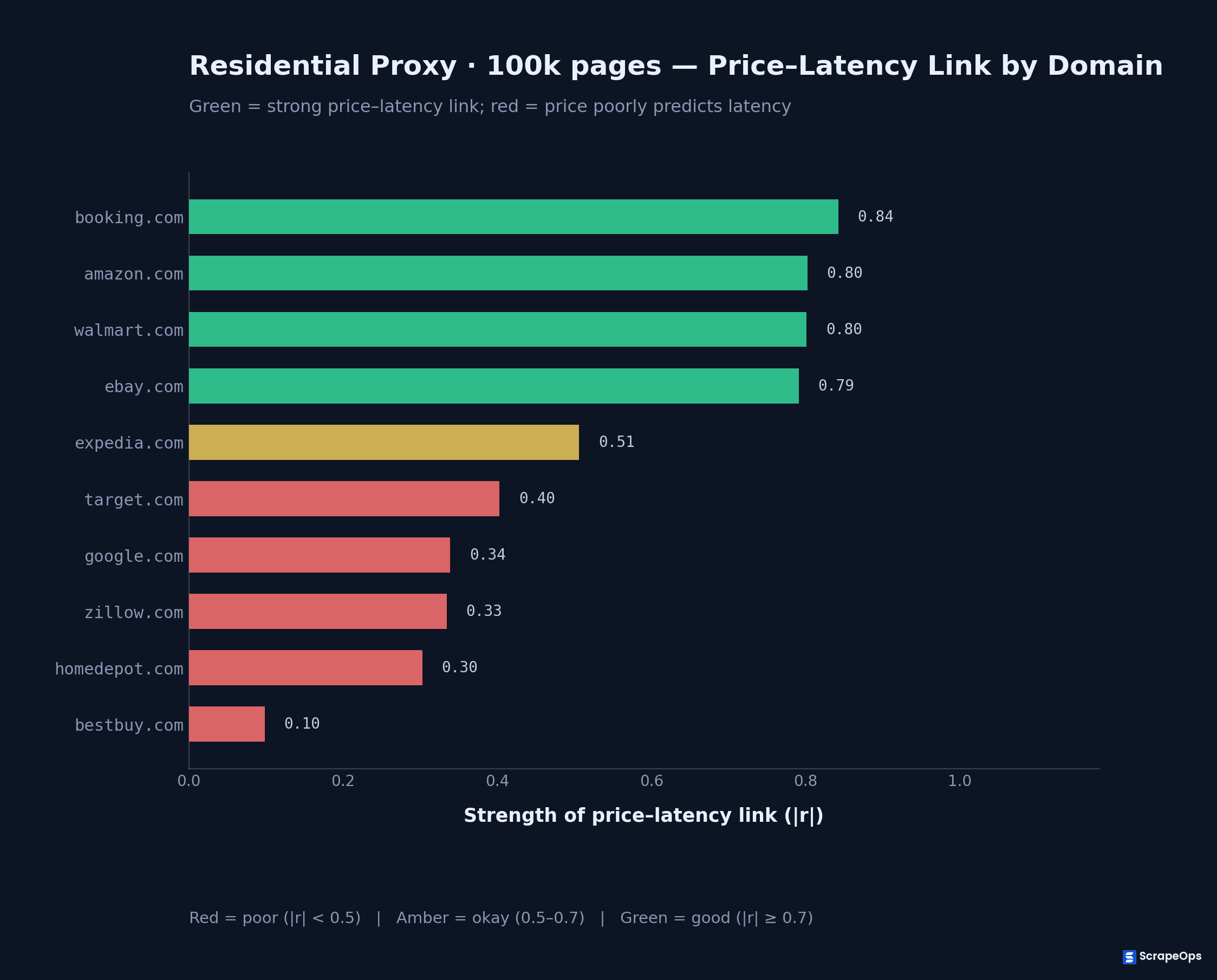
Residential proxies, same verdict. Price is either a strong signal or no signal, rarely anything in between.
On 5 of 9 residential domains price is a poor predictor, and on the other 4 it's strong, with nothing in the middle.
The Verdict
Two completely different markets that share very little in common agree on the one thing that matters here: the number on the pricing page is not a performance number.
Price isn't a broken signal. It's an unreliable one. It works sometimes, fails often, and never warns you which it's about to do.
That unreliability is the whole problem. If price never predicted performance, you'd just ignore it.
Because it works often enough to feel trustworthy, it lures you into guessing. And the data has more to say about why guessing loses.
The Best Provider Changes with the Site
From looking at the data, we've seen that price doesn't predict performance.
But if we look deeper, we can also see that the best provider changes with the site you're scraping.
Making finding the best proxy provider an even more complex problem.
In the following chart, we've plotted the top 3 Web Scraping API providers for each site at 100k pages a month.
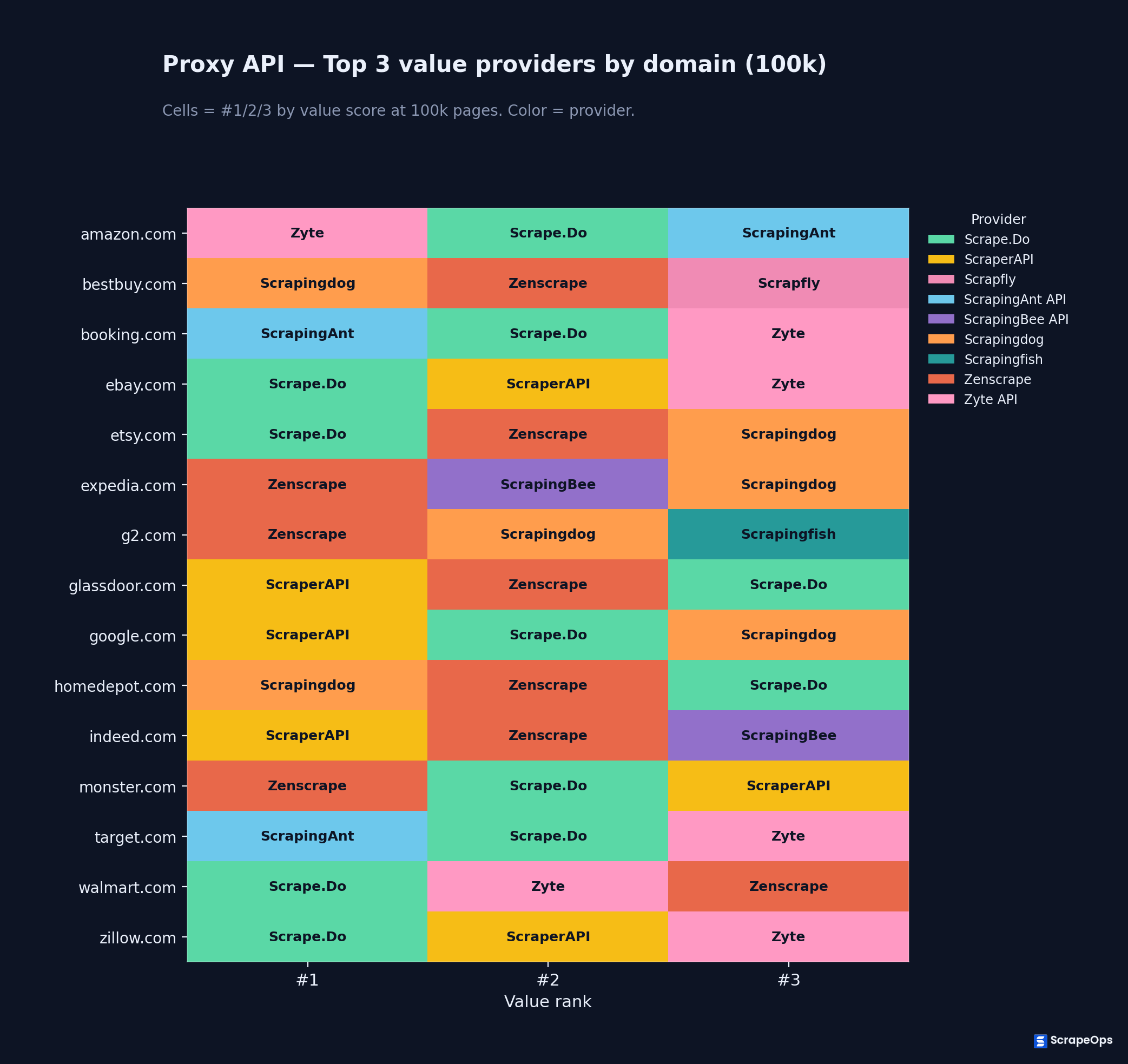
As you can see from the chart, the variation in the top 3 providers is massive.
In only 2 cases are the top 3 providers the same.
- booking.com and target.com: #1 ScrapingAnt, #2 Scrape.do, #3 Zyte
- ebay.com and zillow.com: #1 Scrape.do, #2 ScraperAPI, #3 Zyte
For every other site, the top 3 providers are different.
We see the same pattern across all the residential proxy providers we tested as well. Albeit with less variation in the top 3 providers.
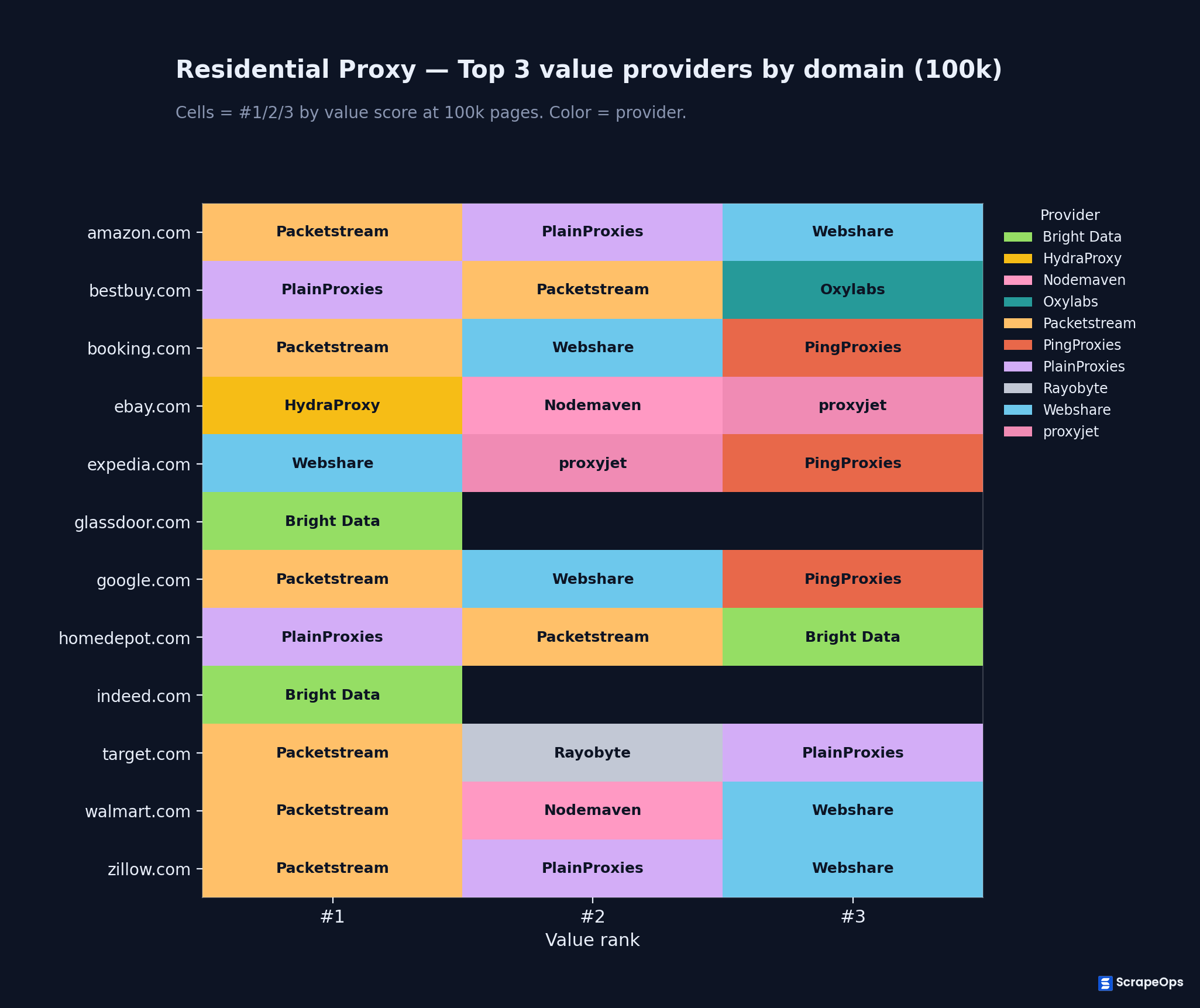
This shows us something important.
Not only is price a weak guide, but the best provider changes with the site you're scraping.
And this can be a very costly mistake to make.
Pricing Varies Widely Between Providers
If you choose the wrong provider, you may be paying far more for less performance.
Not just paying 10-20% more, but 5-10X more.
Looking at Amazon.com again as an example. Here is the price and performance data to scrape 100k pages a month with a Web Scraping API whilst achieving a sub 15 seconds average success latency.
| Provider | Lowest price | Plan | Avg. success latency | Success rate |
|---|---|---|---|---|
| ScrapingAnt | $19/month | Enthusiast | 13.19s | 93.33% |
| Zyte API | $23 PAYG | PAYG | 6.56s | 100% |
| Scrape.do | $29/month | Basic | 5.20s | 100% |
| Scrapingdog | $40/month | Lite | 5.06s | 66.67% |
| ScrapingBee | $49/month | Freelance | 7.50s | 100% |
| ZenRows | $49/month | Freelance | 4.85s | 46.67% |
| Zenscrape | $59/month | Small | 2.70s | 53.33% |
| ScraperAPI | $99/month | Startup | 8.99s | 100% |
| Scrapingfish | $200/month | 100K Requests | 6.74s | 100% |
| Bright Data Web Unlocker | $300/month | Experimenting Web Unlocker | 4.18s | 100% |
The difference here between the lowest price and the highest price is 15X.
Granted Bright Data Web Unlocker is 3X faster than ScrapingAnt (4.18s vs 13.19s), but even if you compare it to Zenscrape which is 2X faster than Bright Data Web Unlocker (2.70s vs 4.18s), you're still paying 6X more for the same performance.
The same pattern is repeated across all the domains we tested.
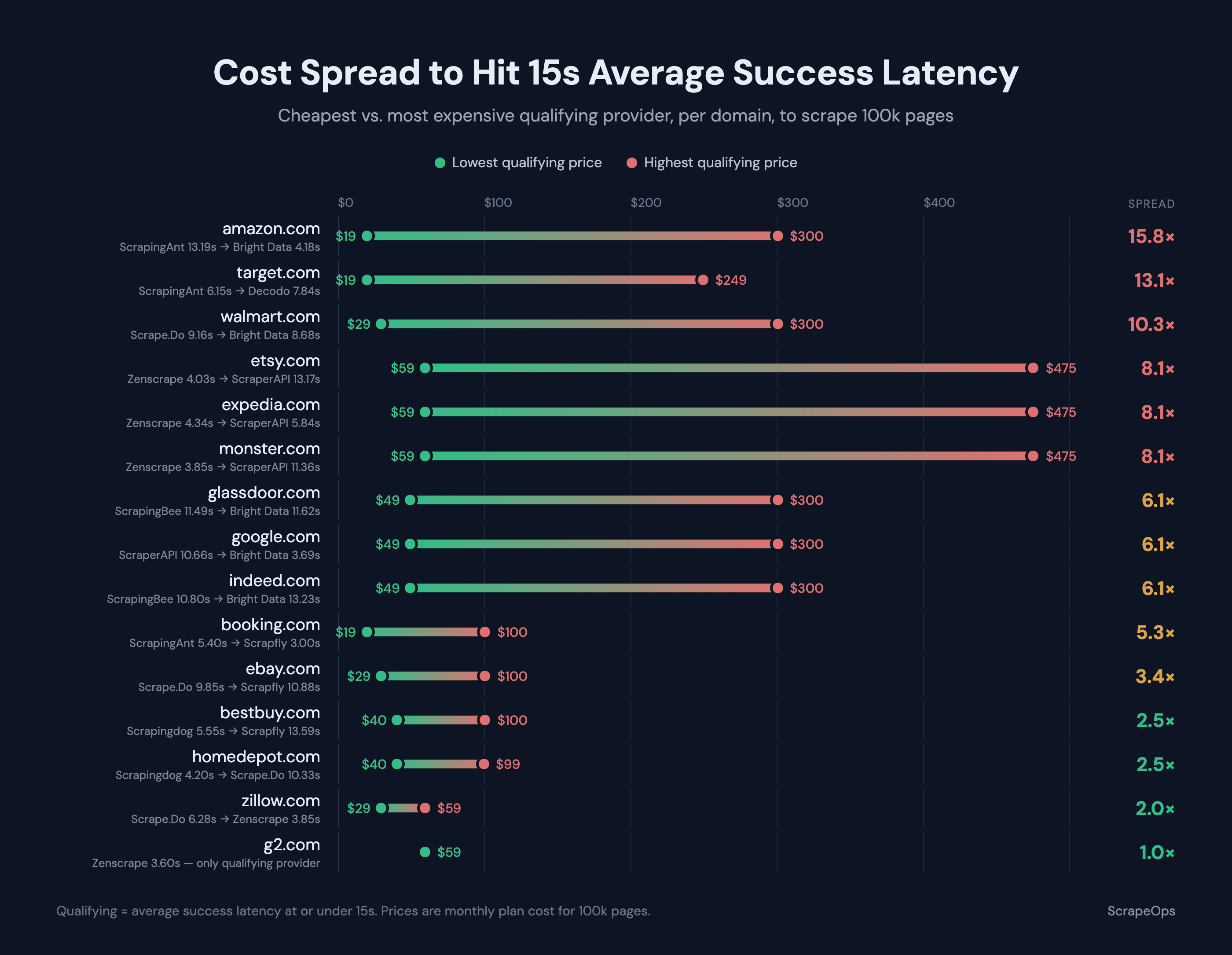
Demonstrating that picking the wrong provider can be a very costly mistake.
The Best Provider Changes with the Volume
Finally, to make things even more complex, when you run this testing for different scraping volumes you'll see that the best provider changes with the volume you're scraping.
Because of variations in pricing structures between providers, the same best-value ranking moves when you change nothing but the number of pages you want to scrape.
Let's look at Amazon.com again for example, but this time at 10k, 100k and 1M pages a month.
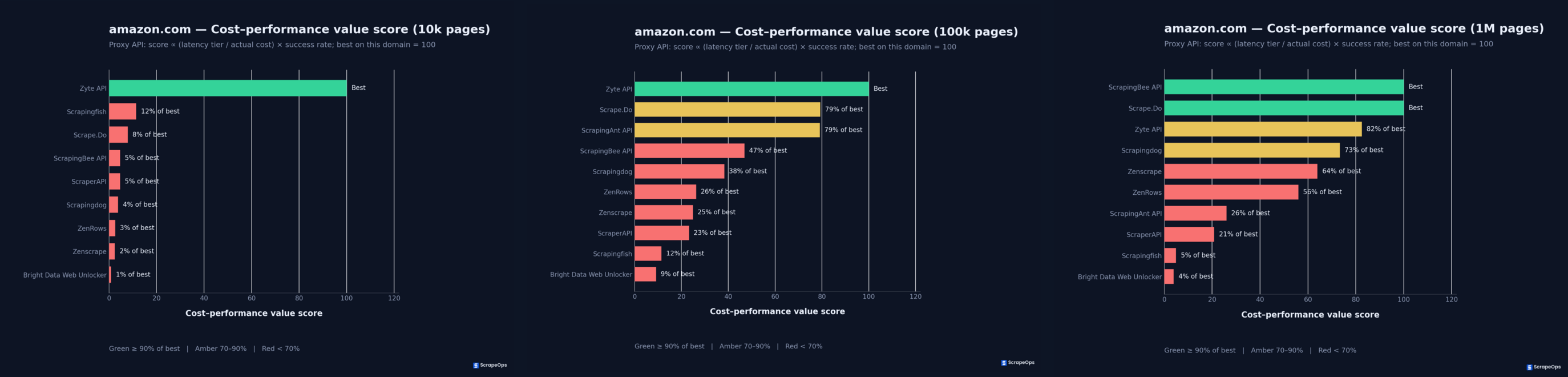
As you can see, the best value provider is different at each volume.
- At 10k pages a month, Zyte API is the clear winner
- By 100k pages a month, Zyte is facing stiff competition from Scrape.do and ScrapingAnt.
- Then by 1M pages a month, ScrapingAnt and Scrape.do overtake Zyte to be the best value providers for scraping Amazon.com.
We see the same pattern across nearly all the domains we tested against. The best provider is consistently changing with volume.
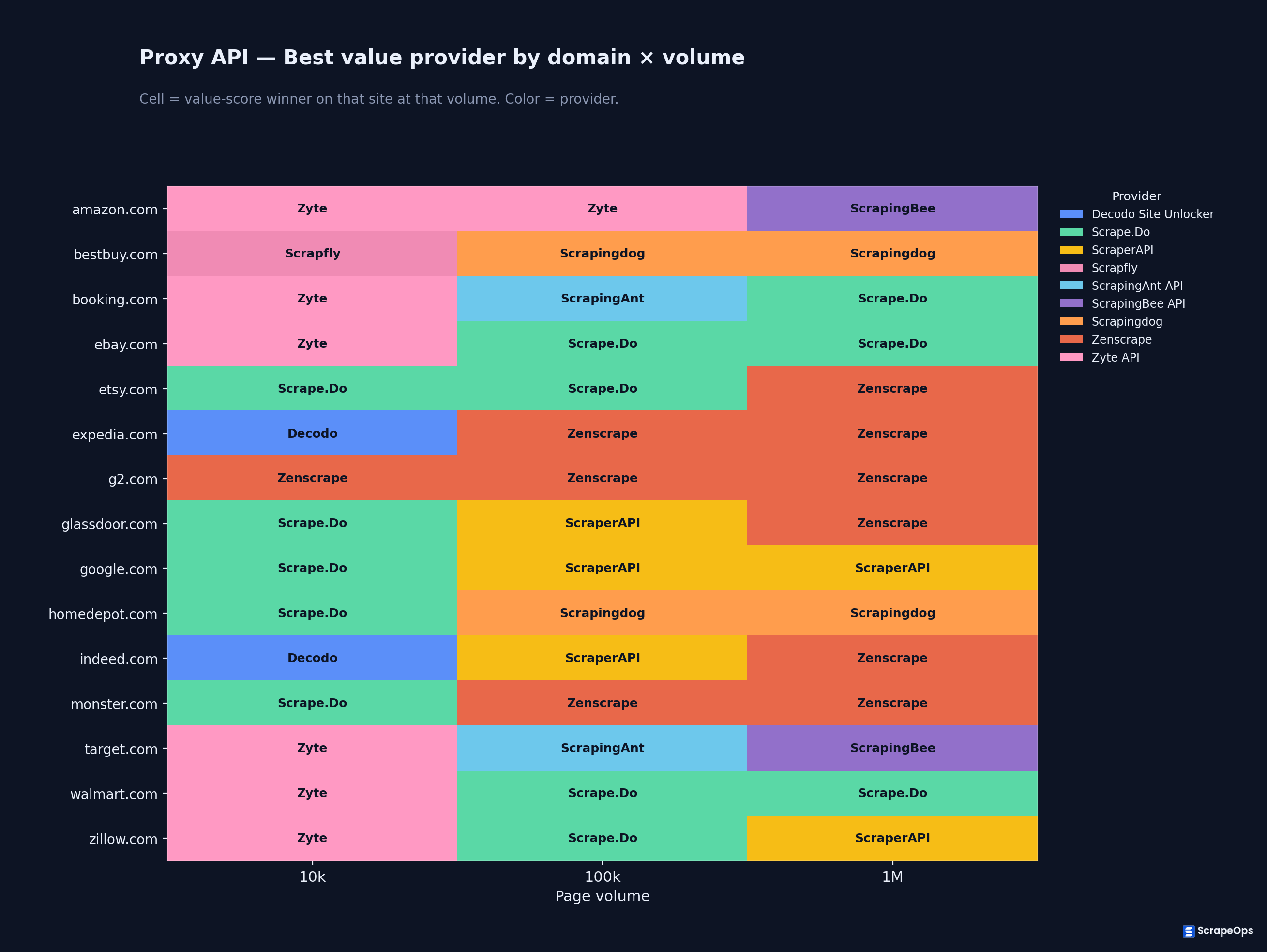
It is very rare for the best provider at small volume (10,000 pages a month) to be the same as the best provider at large volumes (1,000,000 pages a month).
The same is true for the best Residential Proxy Providers.
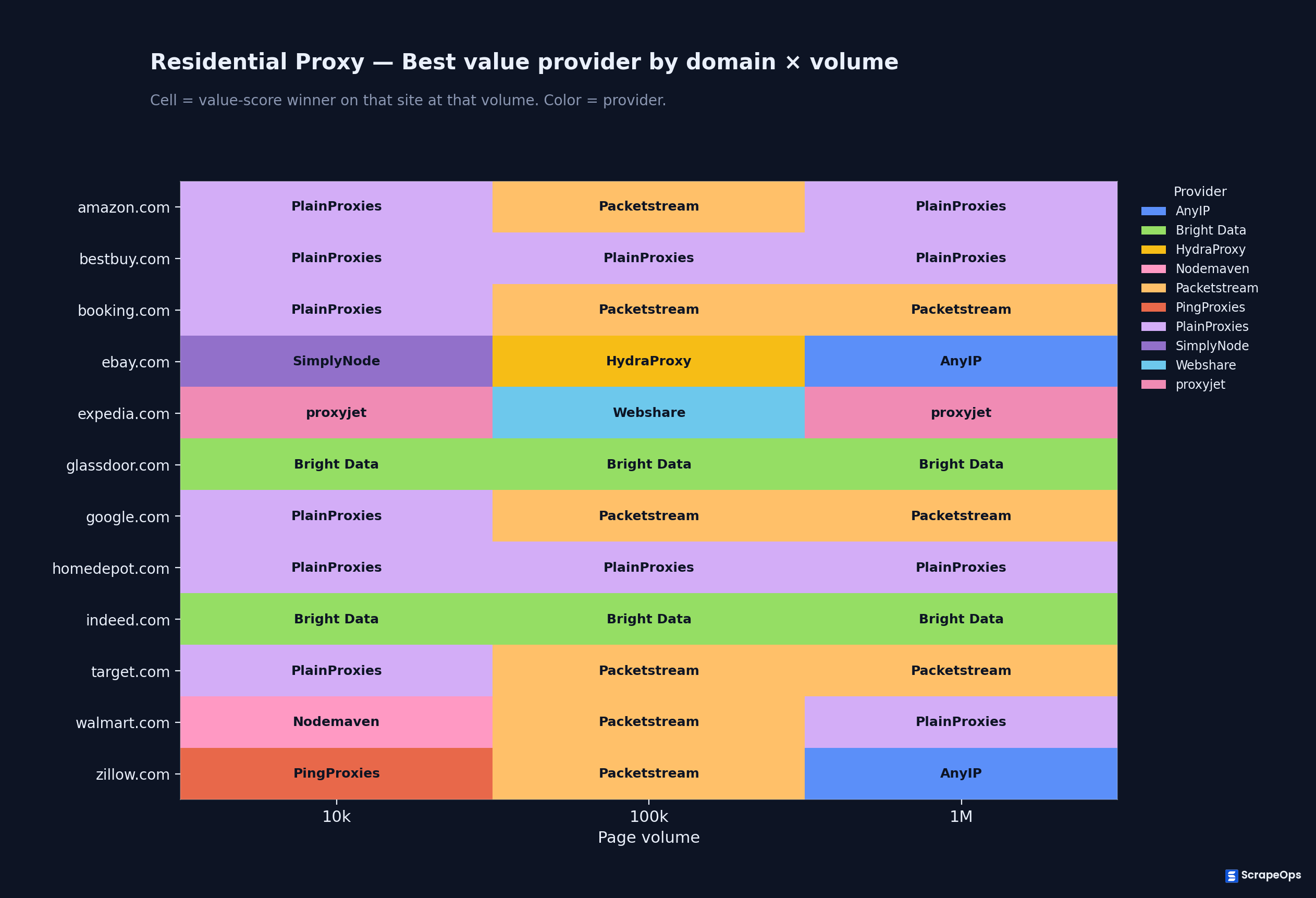
Across the 27 sites we tested (15 Web Scraping APIs and 12 Residential Proxy Providers), the best provider only remains the same in 4 instances from 10k to 1M pages.
About 15% of the time, the best provider remains the same.
To access the pricing data for the different volumes, we used the same performance data but then identified the most suitable plan for each volume from each provider's published pricing.
The winner flips purely because pricing structures differ by tier. Every provider has its own discount curve, and those curves cross. A provider that's expensive per page at 10k can become the cheapest at 1M, and the other way round.
This data shows a flaw in how most developers choose a proxy provider.
Typically, developers will start testing a proxy provider with a small volume (10,000 pages a month) before scaling up to a large volume like 1,000,000 pages a month.
However, what the data shows is that the provider that gave the best value at 10,000 pages a month may not give the best value at 1,000,000 pages a month.
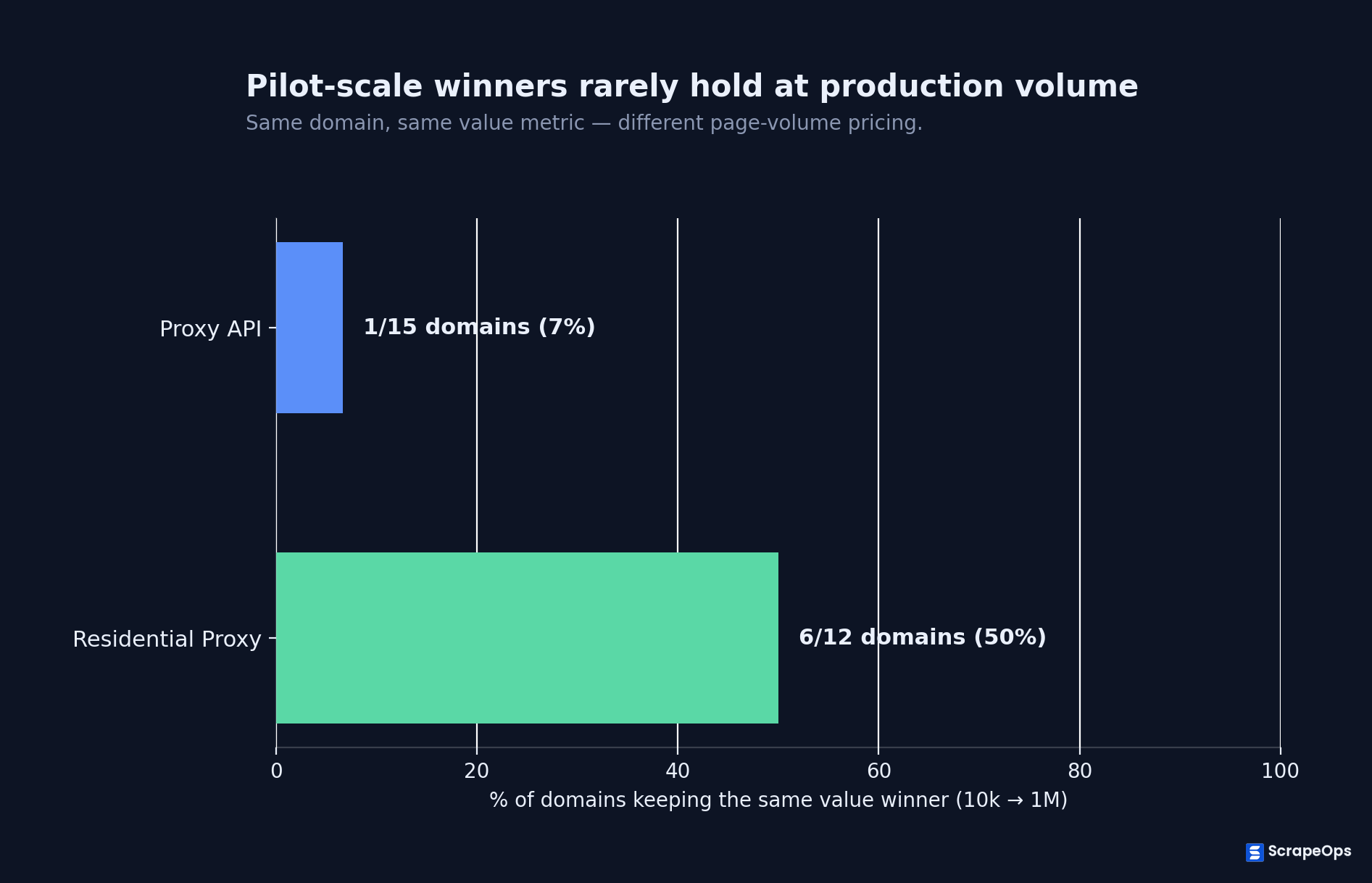
So performance changes the winner by site, and pricing changes the winner by volume. Both move at once. The idea of a single best provider doesn't survive either force on its own, let alone the two together.
Takeaway: The Only Way To Find The Best Provider Is To Test Your Own Use Case
From looking at the data, one thing becomes very clear.
There is no best proxy provider. You shouldn't trust any proxy provider's marketing claims, or "best proxy provider" rankings.
There is only a best provider for your specific use case and volume.
The only way to find the best proxy provider is to test your own use case across all the proxy providers you're considering.
Looking at:
- Performance: The success rate and average latency of every provider to return a valid successful request.
- Cost: The cost of every provider to scrape a set number of pages.
- Value: The performance you get per dollar at a given volume.
This will give you a clear picture of which provider is the best for your specific use case.
This can be a time-consuming and expensive process, but it is the only way to find the best proxy provider for your specific use case.
However, if you would like to save yourself some time and effort, we have created a free proxy testing tool that will help you find the best proxy provider for your specific use case.
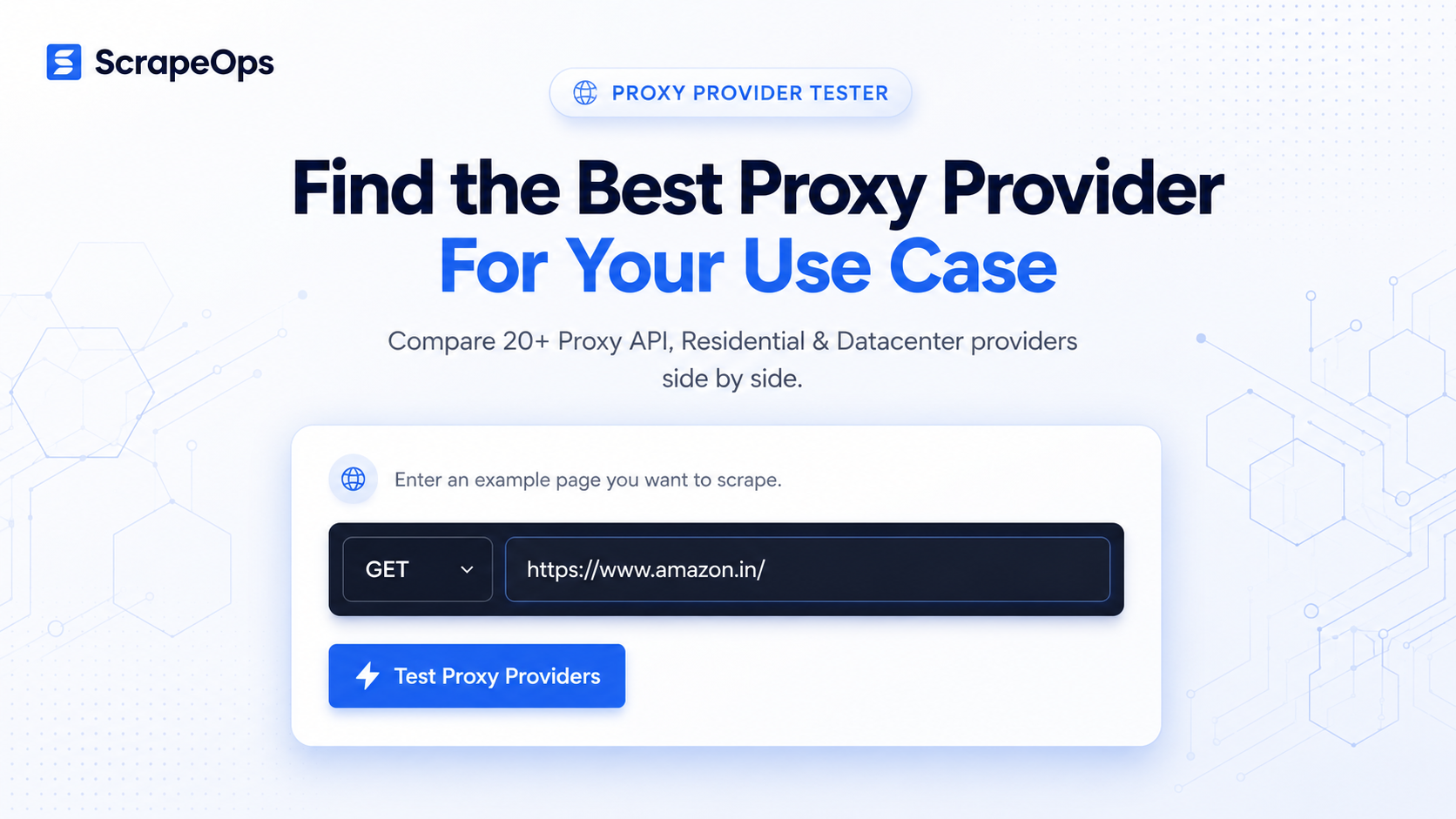
Simply enter the sites you want to scrape, the volume you want to scrape them at, and the proxy tester will test over 20 different proxy providers across both Web Scraping APIs and Residential Proxy Providers and give you a clear picture of which provider is the best for your specific use case.
Who Is The Best Proxy Provider?
All that being said, after running all these tests we were curious to see who was the best proxy provider across all the sites we tested.
If you were to say, "Who is the best proxy provider?" who would come out on top...
Best Hobby Proxy Provider
If you are scraping at small volumes (10,000 pages a month) for a small project, who is the best proxy provider?
Again, the best proxy provider will vary based on domain. If you had to pick just one provider for your project, who should you choose?
Best Small Volume Web Scraping API
At 10,000 pages a month, the best value provider is Zyte API.
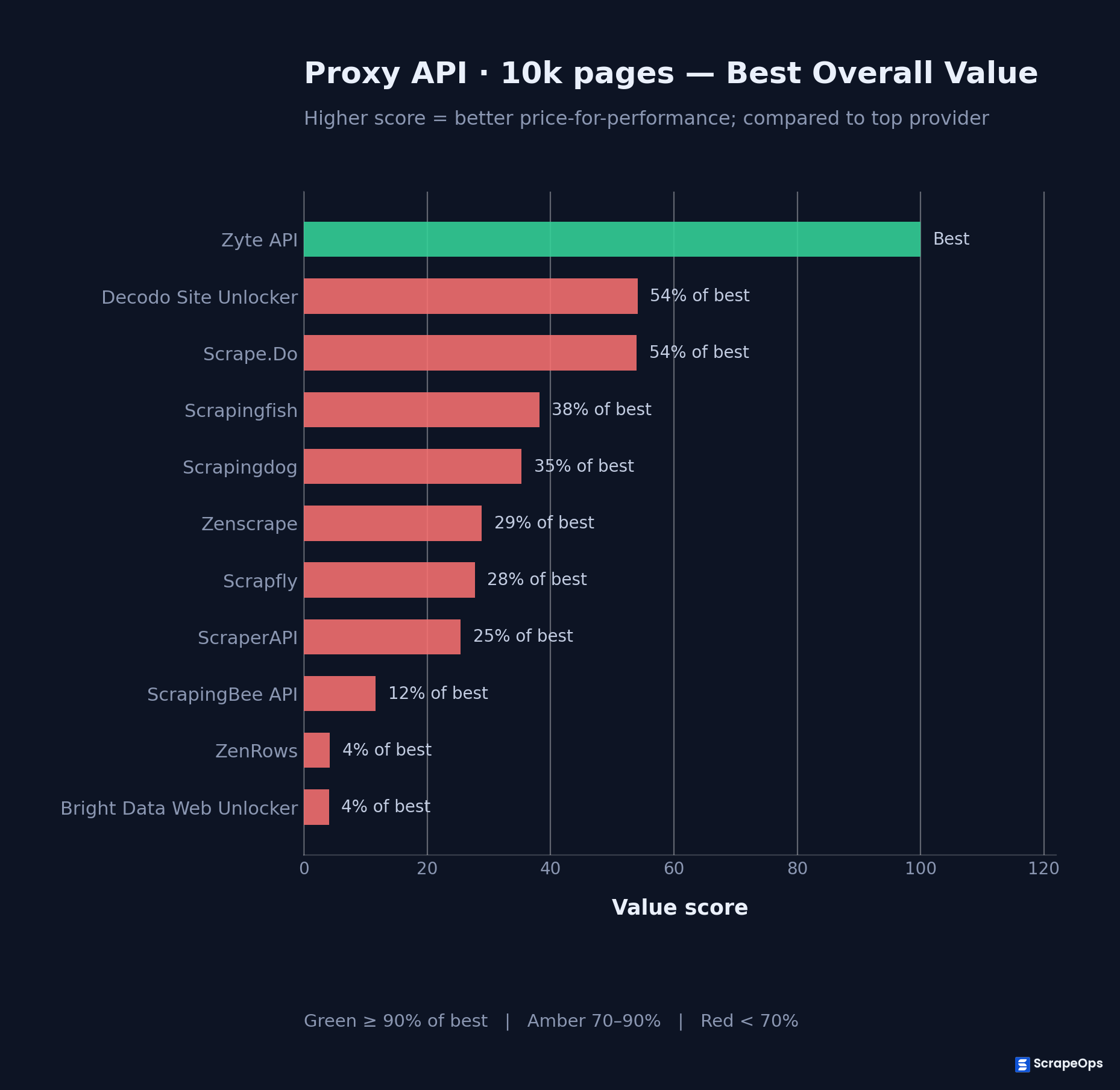
Zyte offers robust performance and reliability across most domains. And because of their Pay-As-You-Go pricing model, you only pay for what you use, so Zyte often works out as the cheapest provider at 10,000 pages a month.
| Rank | Provider | Value vs. best |
|---|---|---|
| 1 | Zyte API | Best |
| 2 | Decodo Site Unlocker | 54% of best |
| 3 | Scrape.do | 54% of best |
| 4 | Scrapingfish | 38% of best |
| 5 | Scrapingdog | 35% of best |
| 6 | Zenscrape | 29% of best |
| 7 | Scrapfly | 28% of best |
| 8 | ScraperAPI | 25% of best |
| 9 | ScrapingBee API | 12% of best |
| 10 | ZenRows | 4% of best |
| 11 | Bright Data Web Unlocker | 4% of best |
Best Small Volume Residential Proxy Provider
At 10,000 pages a month, the best value provider is PlainProxies.
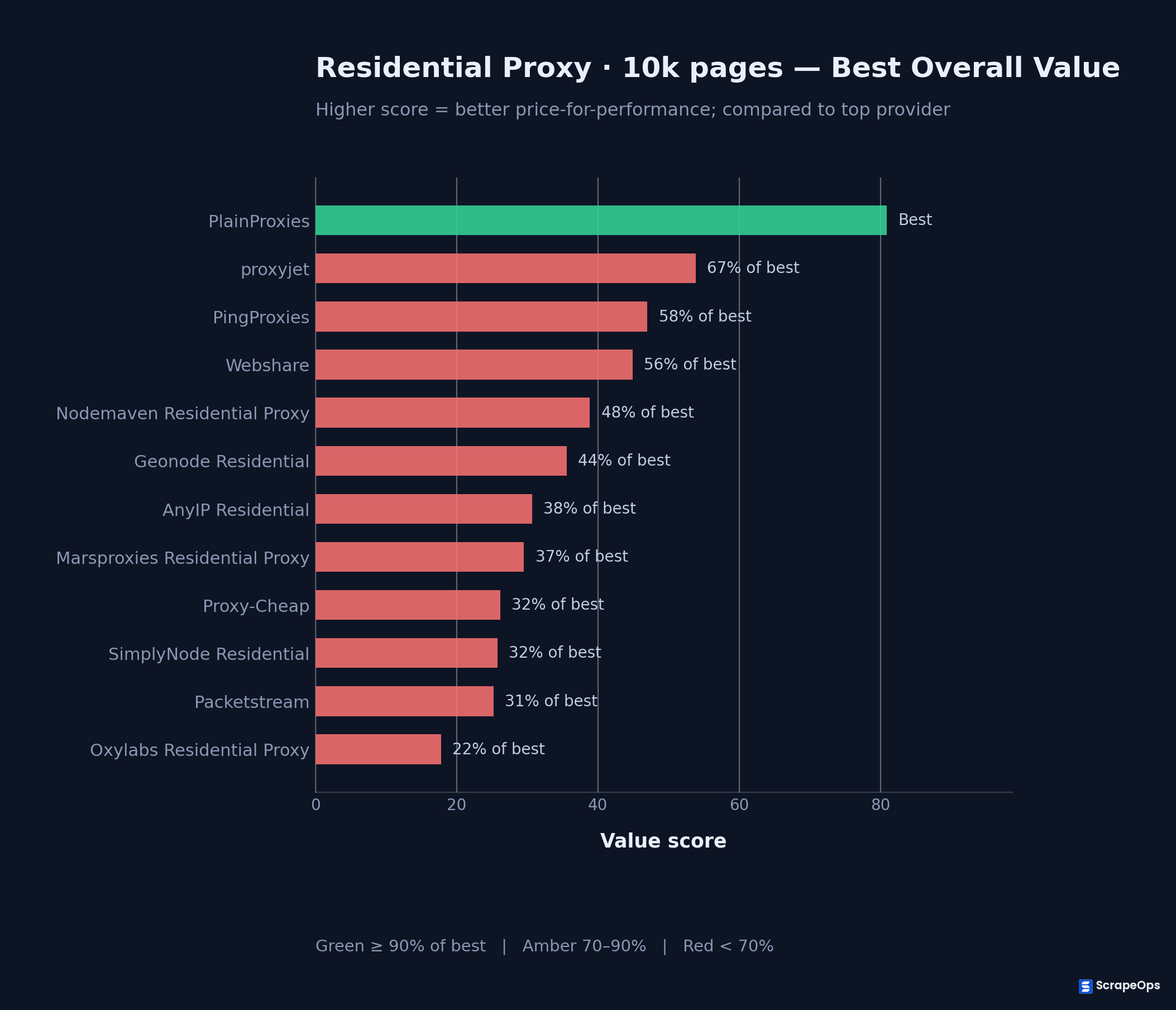
Across all the domains we tested, PlainProxies offered the best combination of performance and cost at 10,000 pages a month.
| Rank | Provider | Value vs. best |
|---|---|---|
| 1 | PlainProxies | Best |
| 2 | proxyjet | 67% of best |
| 3 | PingProxies | 58% of best |
| 4 | Webshare | 56% of best |
| 5 | Nodemaven Residential Proxy | 48% of best |
| 6 | Geonode Residential | 44% of best |
| 7 | AnyIP Residential | 38% of best |
| 8 | Marsproxies Residential Proxy | 37% of best |
| 9 | Proxy-Cheap | 32% of best |
| 10 | SimplyNode Residential | 32% of best |
| 11 | PacketStream | 31% of best |
| 12 | Oxylabs Residential Proxy | 22% of best |
Best Enterprise Proxy Provider
Then if you are scraping at enterprise volumes (1,000,000 pages a month) for a large project, who is the best proxy provider?
Best Enterprise Web Scraping API
At 1,000,000 pages a month, the best value provider is Scrape.do.
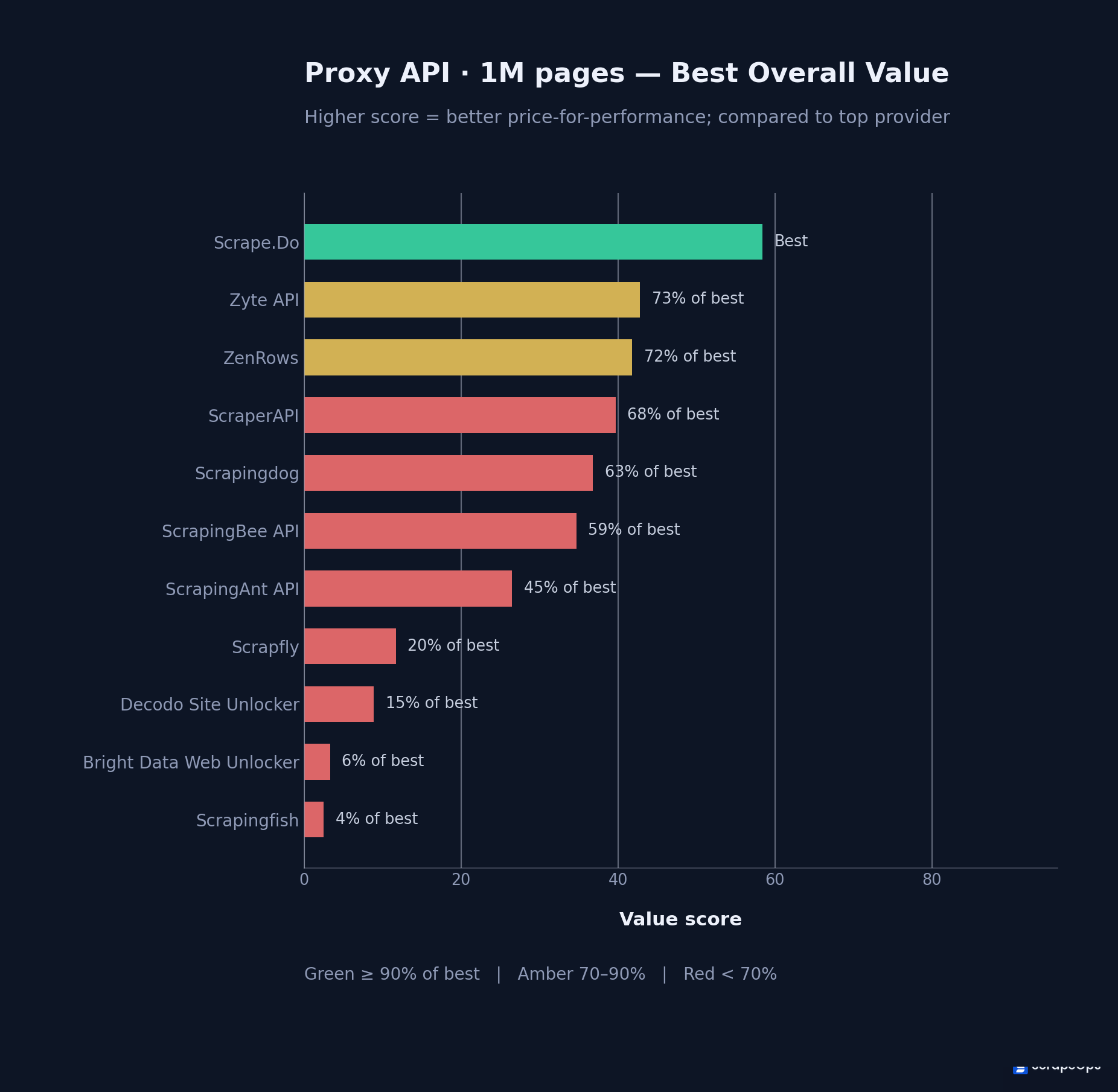
During testing, Scrape.do offered the most robust performance and reliability for the lowest cost.
| Rank | Provider | Value vs. best |
|---|---|---|
| 1 | Scrape.do | Best |
| 2 | Zyte API | 73% of best |
| 3 | ZenRows | 72% of best |
| 4 | ScraperAPI | 68% of best |
| 5 | Scrapingdog | 63% of best |
| 6 | ScrapingBee API | 59% of best |
| 7 | ScrapingAnt API | 45% of best |
| 8 | Scrapfly | 20% of best |
| 9 | Decodo Site Unlocker | 15% of best |
| 10 | Bright Data Web Unlocker | 6% of best |
| 11 | Scrapingfish | 4% of best |
Best Enterprise Residential Proxy Provider
At 1,000,000 pages a month, the best value provider is PacketStream.
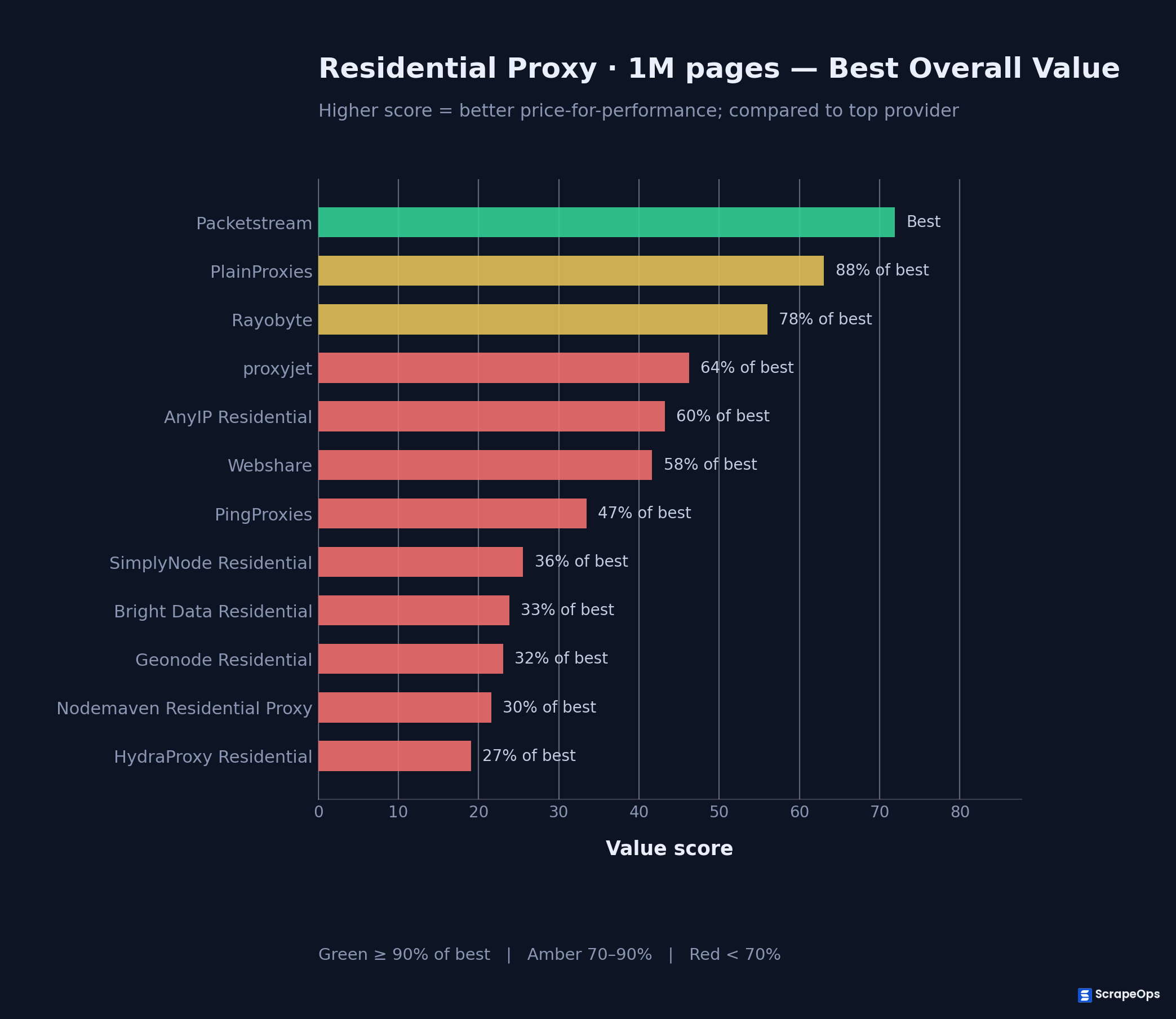
Across all the domains we tested, PacketStream offered the best combination of performance and cost at 1,000,000 pages a month with its $1/GB pricing.
| Rank | Provider | Value vs. best |
|---|---|---|
| 1 | PacketStream | Best |
| 2 | PlainProxies | 88% of best |
| 3 | Rayobyte | 78% of best |
| 4 | proxyjet | 64% of best |
| 5 | AnyIP Residential | 60% of best |
| 6 | Webshare | 58% of best |
| 7 | PingProxies | 47% of best |
| 8 | SimplyNode Residential | 36% of best |
| 9 | Bright Data Residential | 33% of best |
| 10 | Geonode Residential | 32% of best |
| 11 | Nodemaven Residential Proxy | 30% of best |
| 12 | HydraProxy Residential | 27% of best |
The Bottom Line
There is no best proxy provider. The data kills that idea three times over:
- Price does not predict performance. On most sites, paying more does not buy a faster or more reliable scrape.
- The best provider changes with the site. Top-3 value rankings barely overlap across domains, and the wrong pick can cost 5–15X more for the same or worse results.
- The best provider changes with volume. Across 27 site tests, the winner stayed the same from 10k to 1M pages only about 15% of the time. A cheap pilot is a bad guide to who wins at scale.
If you need a single aggregate pick: Zyte API and PlainProxies lead at hobby volume (10k pages). Scrape.do and PacketStream lead at enterprise volume (1M pages).
But the real answer is simpler. There is only the best provider for your sites, at your volume. Price won't reveal it. Brand won't reveal it. Rankings won't either. Test your own use case, and the best provider stops being a matter of opinion and becomes a matter of record.
Methodology
The following analysis was conducted using the following methodology:
Performance Benchmarking
To access the performance data of the different proxy providers, we used a combination of ScrapeOps's own production proxy data from our web scraping API and residential proxy providers, and regular benchmark runs for the target websites.
This data was collected over a one month period, from July 1st to July 31st 2026, and the overall performance metrics were calculated.
Performance was measured using the average success latency metric, which measures the average time it takes for a proxy provider to return a valid successful request.
This metric looks at only valid responses from the proxy provider, and does not include any failed requests or responses that contain errors or ban pages.
As a result, average success latency includes both the success rate and the latency of the request, giving an accurate measure of how many successful responses a user can expect to receive from a proxy provider through a single concurrent thread.
Pricing Benchmarking
To access the pricing data of each proxy provider, we first collected the published pricing for each provider's Web Scraping API and Residential Proxy Provider plans.
Then we calculated how many API credits (for Web Scraping APIs) or GB (for Residential Proxy Providers) are required to scrape a target number of pages.
From here, we determined which provider's plan was the most cost effective for each target number of pages. Choosing the cheapest plan from each provider that allowed for the target number of pages to be scraped.
For Web Scraping APIs, these calculations factored in API credit multipliers for extra functionality like residential proxies, JS rendering, anti-bot bypasses, and domain-specific multipliers.
Value Calculation
Once we had the performance and pricing data for each proxy provider, we calculated the value score for each provider on each site.
Value score is calculated by finding the best proxy providers in specific performance ranges (average success latency < 10s, 10-20s, 20-30s, +30s) and computing a value score based on the price of the plan that allowed for the target number of pages to be scraped.
The target average success latency used was 20s across all sites.
This gives us a score that represents the performance you get per dollar at a given volume.